


Nikolay Hristov, Victor Georgiev
Todor Kableshkov University of Transport, Sofia, Bulgaria
https://doi.org/10.53656/isct-2025.28

Pages 324-334
Abstract. The article presents a comprehensive study on optimizing laser cutting processes by analyzing the influence of key technological parameters – cutting speed, laser power, and auxiliary gas pressure -on the accuracy and quality of cuts in C235 steel. The research employs a Design of Experiments (DOE) methodology, specifically the Extended Central Composition design, to systematically investigate how these parameters affect geometric precision and the heat-affected zone (HAZ) on both sides of the laser cut.
The study begins by outlining the fundamentals of laser cutting, emphasizing the importance of controlling process parameters to achieve high-quality results. It highlights that while previous research has focused on cut quality, few have addressed the accuracy of specific geometric shapes. The authors aim to fill this gap by developing a methodology that minimizes experimental trials while maximizing insight into parameter effects.
Using a Durma HD-F 4020/4KW fiber laser, the researchers conducted experiments on 3mm thick C235 steel samples shaped into 10mm squares. Measurements of diagonal deviations and HAZ widths were taken from both the upper and lower sides of the cuts. The DEFMOT method, developed by the authors, was used to analyze the differences in shape accuracy and thermal effects.
Regression models were derived to quantify the relationship between input parameters and output quality indicators. The results showed that increasing gas pressure and cutting speed generally led to greater differences in accuracy between the two sides of the cut. However, the influence of laser power was less consistent. The models demonstrated high correlation coefficients (R > 0.95), indicating strong predictive capabilities.
The study concludes that a multifactorial approach enables precise control over laser cutting outcomes. The developed methodology allows for the prediction and optimization of dimensional accuracy and thermal effects, contributing to more efficient and reliable laser cutting processes in industrial applications.
Keywords: Technological parameters of laser cutting; DOE; Laser quality
- Introduction
In typical melting laser cutting, the laser energy melts the material and the assist gas jet removes the molten material [1, 2]. Therefore, less laser energy is required compared to cutting by evaporation [3]. The laser heat is combined with an exothermic chemical reaction with the auxiliary gas and provides the heat required to melt and evaporate the cut material. A number of fundamental studies have been carried out in the field of laser cutting [4], in which the quality has been investigated, without however affecting the accuracy of cutting a particular geometric shape. Nevertheless, the literature cited defines multi-criteria process parameters related to cut quality. Higher laser power generally increases the material removal rate, but can also increase the surface roughness if not properly controlled. It has been studied in the literature [5] that optimisation of parameters such as laser power, pulse frequency and cutting speed can minimise surface roughness and improve cut quality. In order to provide a solution for precision laser cutting of materials, it is necessary to control the accuracy and quality depending on the technological parameters. Such an approach provides solutions to achieve complex geometries with increased requirements. Although individual parameter optimisation would be required for each new target, geometry or material class, it is desirable to base the optimisation process on as few experiments as possible to determine the direction of the search. To search for such a methodology, a central-optimal compositional design was selected from the DOE with the response surface.
In fact, different types of laser systems already exist, including gas-assisted systems. Such systems offer many advantages, including high quality output. The selection of the most suitable process parameters becomes an important practical task to improve both the quality of the product and the productivity of laser cutting. Identification of individual control factors on geometrical and other parameters of the cut material is precisely the solution of the productivity problem as a compromise of a modern technological solution [6].
Design of Experiments (DOE) is a systematic method that has been applied to many optimisation problems. The Response Surface Method (RSM) [7].
The objective of the study is to compose a knowledge-based approach using specified parameters from the DOE of the laser cutting process to achieve the desired results in terms of a set of quality parameters. The approach demonstrates how controlling parametric combinations of cutting speed, auxiliary gas pressure, power and frequency leads to better surface quality of laser cut samples. The quality of the resulting cut is determined by pre-selected quality indicators such as geometric accuracy, cutting slope and temperature shock width. To achieve the objective, an experimental parametric analysis plan, Extended Central Composition (by Roland A. Fisher), is applied to laser-cut billets of elementary geometric shape of C235 steel. On the basis of the conducted experiment and the results of the study, a generalised methodology is created using the author’s DEFMOT approach [8, 9]. With the help of the methodology it is necessary to analyse the deviation of quality parameters depending on the design of technological modes.
- Problem statement and research and measurement methods.
In this section, first of all, the problem of the objective of the study – optimisation of laser cutting parameters in order to minimise the error in the slope accuracy in the dimensions and the width of the temperature zone of the cut – is defined, and the factors and levels of the input control parameters are identified.
The main factors influencing the quality of the cut in laser cutting are
– Cutting speed (S).
– Laser power (P).
– Auxiliary gas pressure (G).
The problem statement involves creating a 3D model of a sample, a square with a side size of 10 mm, in CAD software. This CAD model was then converted into a DXF file and fed into the laser cutting machine, Fig. 1.
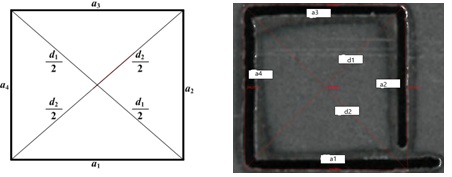
Figure 1. Significance of the modified ideal quadrant for different combinations of process factors compared to the CAD model
The equipment used is a Durma HD-F 4020/4KW fibre laser with a 3mm thick cut sheet. The object of study is the most widely used rolled steel C235. Its chemical composition is given in Table 1.
Table 1. Chemical composition of C235 steel
| C | Si | Mn | Ni | S | P | Cr | N | Cu |
| ≤0,22 | ≤0,05 | ≤0,60 | ≤0,30 | ≤0,040 | ≤0,040 | ≤0,30 | ≤0,012 | ≤0,30 |
The laser head has an integrated sensor system that monitors the cutting process and provides relevant information to the operator. In this way, it is possible to carry out the technological modes required to achieve the objectives of the study. The control modes of the experiments are changed according to the combinations indicated in Table 2, carefully for each different line of the plan. After the cutting process, the square specimens are removed from the sheet frame and the results of the diagonals on both sides described in Table 2 are obtained on the basis of the measurements for each combination on both sides of the contact surface. All values given in Table 2 are quantitative numerical measurements calculated on a pixel basis.
Table 2. Influence of different combinations of input process parameters on the investigated output parameters measured on both sides of the cut
| № upper side I |
V, m/min | P, W | p, bar | d I1 | d I2 | HAZ I sr |
| 1 | 2400 | 1700 | 11,130 | 15,741 | 15,680 | 0,370 |
| 2 | 3000 | 1700 | 11,172 | 15,741 | 15,860 | 0,365 |
| 3 | 2400 | 2500 | 11,215 | 15,920 | 15,890 | 0,391 |
| 4 | 3000 | 2500 | 11,172 | 15,860 | 15,890 | 0,391 |
| 5 | 2400 | 1700 | 11,172 | 15,861 | 15,771 | 0,391 |
| 6 | 3000 | 1700 | 11,130 | 15,861 | 15,771 | 0,339 |
| 7 | 2400 | 2500 | 11,172 | 15,861 | 15,800 | 0,391 |
| 8 | 3000 | 2500 | 11,257 | 15,891 | 15,981 | 0,360 |
| 9 | 3000 | 2100 | 11,257 | 15,860 | 15,861 | 0,344 |
| 10 | 2400 | 2100 | 11,215 | 15,890 | 15,890 | 0,397 |
| 11 | 2700 | 2500 | 11,215 | 15,950 | 15,890 | 0,391 |
| 12 | 2700 | 1700 | 11,172 | 15,920 | 15,771 | 0,391 |
| 13 | 2700 | 2100 | 11,299 | 15,980 | 15,950 | 0,365 |
| 14 | 2700 | 2100 | 11,299 | 15,980 | 15,920 | 0,365 |
| №
down side II |
V mm/min | P, W | p, bar | d II 1 | d II 2 | HAZ II sr |
| 1 | 2400 | 1700 | 11,046 | 15,741 | 15,892 | 0,571 |
| 2 | 3000 | 1700 | 11,088 | 15,651 | 15,920 | 0,608 |
| 3 | 2400 | 2500 | 11,215 | 15,890 | 16,011 | 0,656 |
| 4 | 3000 | 2500 | 11,172 | 15,771 | 15,981 | 0,693 |
| 5 | 2400 | 1700 | 11,088 | 15,651 | 15,801 | 0,603 |
| 6 | 3000 | 1700 | 11,046 | 15,621 | 15,801 | 0,651 |
| 7 | 2400 | 2500 | 11,130 | 15,801 | 15,861 | 0,656 |
| 8 | 3000 | 2500 | 11,215 | 15,950 | 15,863 | 0,682 |
| 9 | 3000 | 2100 | 11,172 | 15,771 | 15,981 | 0,667 |
| 10 | 2400 | 2100 | 11,215 | 15,831 | 15,980 | 0,608 |
| 11 | 2700 | 2500 | 11,299 | 15,950 | 16,040 | 0,672 |
| 12 | 2700 | 1700 | 11,130 | 15,741 | 15,920 | 0,640 |
| 13 | 2700 | 2100 | 11,130 | 15,741 | 16,010 | 0,698 |
| 14 | 2700 | 2100 | 11,299 | 15,860 | 16,100 | 0,677 |
From the measured diagonals, the difference in shape accuracy on both sides of the cut is determined using a DEFMOT method developed by the author. The details of determining the accuracy difference itself are defined by the algorithm shown in Figure 2. This algorithm determines the influence of individual process input factors on the accuracy difference.
- Analysis of Results and Conclusions
Reliable design is a practical and rational method for optimising product qualities that are minimally sensitive to various causes. For this reason, an experiment was set up to study the combinations for the difference in accuracy on both sides of the cut that determine the best quality. The highly parametric influence of process parameters on the HAZ was evaluated. Since the laser beam speed and power and the cutting gas pressure were assumed to be the key parameters, regression models were derived for Δ – the difference in accuracy based on the algorithm shown in Fig. 2 and ΔHAZ – the difference in temperature influence zones on both sides of the cut with respect to these parameters.
To derive the regression models, the cutting process was repeated continuously for 9 modes with different control setting factors (those in Table 2). The difference between the upper and lower gauge dimensions and the dimensional error (Δ) are determined in the algorithm (Fig. 2). The derived polynomial models are of second order based on standard methodology [10]. All regression models have the form (1) and are derived for coded units:

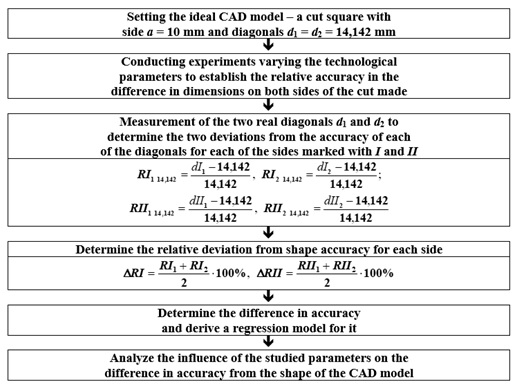
Figure 2
where b are the coefficients of the regression model, xi, xj are the different control factors, l is the total number of control factors, y is the response and ε is the error.
When the data in Table 2 were processed, the following coefficients of model (1) were obtained and it took the following form for the two criteria under study.
Δ – the difference in accuracy on both sides of the cut
(2)
 The multiple correlation coefficient was R =0.9533, and the calculated Fisher’s F criterion of 6.2289 was greater than the tabulated one of 4.8183, (0.05, 8, 5).
Δ HAZ – the difference between the temperature influence areas on both sides of the section
(3)

The coefficient of multiple correlation was R=0.9736 and the calculated Fisher’s F criterion of 8.0949 was greater than the tabulated one of 5.9988, (0.05, 9, 4).
Immediately below the models are the results of their tests, at a selected significance level of 0.05, indicating that the statistical error is 5%.
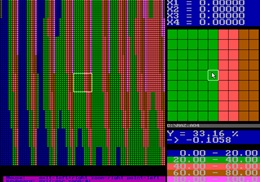
Model (2)
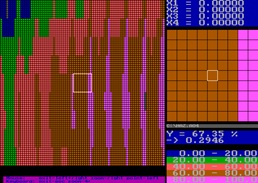
Model (3)
Figure 3. Graphical interpretation of the criteria studied using the illustration given in [9]
The images shown in Fig. 3 were generated using the author’s DEFMOT analysis and optimisation system. This system allows automatic recalculation of the corresponding criterion depending on the control parameters. These calculations are shown graphically in Fig. 4 and Fig. 5.
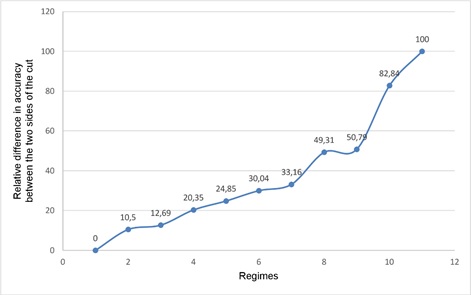
Figure 4. Variation, calculated as a percentage, of Δ, the difference in accuracy between the two sides of the cut, obtained for the regimes listed in Tab. 3.
Table 3. Regimes determining the parametric influence on the accuracy difference
| Regimes | |||||||||||
| 1 | 2 | 3 | 4 | 5 | 6 | 7 | 8 | 9 | 10 | 11 | |
| % | 0 | 10,5 | 12,69 | 20,35 | 24,85 | 30,4 | 31,16 | 49,31 | 50,79 | 82,84 | 100 |
| V, mm/min | 2400 | 2400 | 2400 | 2700 | 2700 | 2700 | 2700 | 2700 | 3000 | 3000 | 3000 |
| P, W | 1700 | 2500 | 2100 | 1700 | 2500 | 2100 | 2100 | 1700 | 2500 | 2100 | 1700 |
| p, bar | 0.4 | 0.4 | 0.4 | 0.4 | 0.4 | 0.4 | 0.5 | 0.6 | 0.6 | 0.6 | 0.6 |
From Fig. 4 and Table 3, it can be seen that the accuracy difference increases with increasing gas velocity and pressure, and in terms of power, the nature of its variation is unidentified and inconsistent.
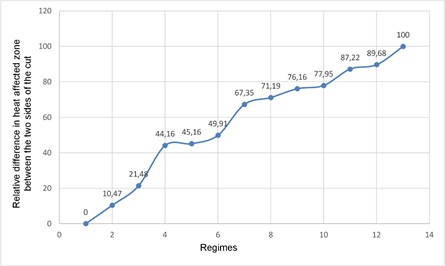
Figure 5. Variation, calculated as a percentage, of Δ HAZ, the difference of the heat affected zones on the two sides of the cut, obtained for the regimes listed in Table 4
Table 4. Regimes determining the parametric influence on the difference of the heat affected zones
on both sides of the cut
| Regimes | |||||||||||||
| 1 | 2 | 3 | 4 | 5 | 6 | 7 | 8 | 9 | 10 | 11 | 12 | 13 | |
| % | 0 | 10,47 | 21,45 | 44,16 | 45,16 | 49,91 | 67,35 | 71,19 | 76,16 | 77,95 | 87,22 | 89,68 | 100 |
| V,
mm/min |
2400 | 2400 | 2400 | 2400 | 3000 | 2400 | 2700 | 3000 | 2700 | 3000 | 3000 | 2700 | 3000 |
| P, W | 1700 | 1700 | 1700 | 2500 | 1700 | 2500 | 2100 | 2500 | 2100 | 1700 | 2500 | 2100 | 1700 |
| p, bar | 0.5 | 0.4 | 0.6 | 0.6 | 0.4 | 0.4 | 0.5 | 0.4 | 0.4 | 0.6 | 0.6 | 0.6 | 0.6 |
From Table 4 it can be seen that no direct correlation can be made between the parameters studied. The model (3) can be used for a specific shape for the steel and thickness studied.
Conclusions
In a planned multifactorial and two-criteria experiment, the influence of the three main technological parameters on the accuracy of the cut contour, measured simultaneously on both sides of the cut, was determined. The steel studied was C235 with a thickness of 3 mm. The study clarified how, by controlling the parametric combinations (such as cutting speed and power, and auxiliary gas pressure), it is possible to predict a better quality in terms of accuracy of laser cut specimens, when both sides of the laser cut are controlled simultaneously. The effects of selected process parameters of the considered process on pre-selected quality indicators were evaluated, and a methodology to optimise the dimensional accuracy on two targets by minimising a function, i.e. the dimensional error, was proposed.
It was found that increasing the gas velocity and pressure increases the relative accuracy difference on both sides of the cut. It was found that there was not a complete correlation between the selected process factors and Δ HAZ, the difference in temperature influence zones on both sides of the cut.
REFERENCES
[1] UHLMANN E., MULLANY, B., BIERMANN, D., RAJURKAR, K., HAUSOTTE, T., BRINKSMEIER, E., Process chains for high-precision components with micro-scale features, CIRP Annals, Volume 65, Issue 2, 2016, 549 – 572, https://doi.org/10.1016/j.cirp.2016.05.001.
[2] FEISTLE M., GOLLE, R., VOLK, W., Determining the Influence of Shear Cutting Parameters on the Edge Cracking Susceptibility of High-strength-steels Using the Edge-fracture-tensile-test, Procedia CIRP, Volume 41, 2016, pp. 1078 – 1083, https://doi.org/10.1016/j.procir.2016.01.007.
[3] SHARMA A., YADAVA, V., Experimental analysis of Nd-YAG laser cutting of sheet materials – A review, Optics & Laser Technology, Vol. 98, 2018, pp. 264 – 280, https://doi.org/10.1016/j.optlastec.2017.08.002.
[4] YI, P.; LIU, Y. C., SHI, Y. et al., Investigation on the process of laser surface melting using two sequential scans. The International Journal of Advanced Manufacturing Technology, 2001, vol. 17, nos. 1 – 4, pp. 225 – 233. ISSN 0268-3768.
[5] PANDEY, A., DUBEY, A., Multiple quality optimization in laser cutting of difficult-to-laser-cut material using grey–fuzzy methodology. The International Journal of Advanced Manufacturing Technology, 2013, vol. 65, nos. 1–4, pp. 421–431. ISSN 0268-3768. doi: 10.1007/s00170-012-4181-5.
[6] GENNA, S., MENNA, E., RUBINO, G., TAGLIAFERRI, V., Experimental Investigation of Industrial Laser Cutting: The Effect of the Material Selection and the Process Parameters on the Kerf Quality. Applied Sciences, 2020, vol. 10, no. 14, article 4956. ISSN 2076-3417. DOI: 10.3390/app10144956.
[7] SHAMLOOEI, M., ZANON, G., BRUGNOLLI, M., VANIN, M., BURSI, O.S. (2024). Optimization of Surface Roughness in Laser Cutting Process of Mild Steel Using RSM and GA Method. In: SILVA, F.J.G., PEREIRA, A.B., CAMPILHO, R.D.S.G. (eds) Flexible Automation and Intelligent Manufacturing: Establishing Bridges for More Sustainable Manufacturing Systems. FAIM 2023. Cham: Springer, 2024, pp. 883–892, Lecture Notes in Mechanical Engineering, ISSN 2195-4356. doi: https://doi.org/10.1007/978-3-031-38241-3_91.
[8] TONTCHEV N., (2014) Materials Science, Effective solutions and Technological variants, Saarbrücken, Germany: LAP LAMBERT Academic Publishing, 2014. 144 p. ISBN: 978-3-659-57778-9.
[9] TONTCHEV, N., GAYDAROV, V., HRISTOV, N., Analyses and Applications of the Computational Approach “Define by Displacement” DEFMOT, Sofia, Todor Kableshkov University of Transport, 2022, 167 p. ISBN 978-954-12-0299-9.
[10] VUCHKOV, I., BOYADJIEVA, L., Quality Improvement with Design of Experiments. A Response Surface Approach, 2001, 508 p. ISSN 1566-0443. https://doi.org/10.1007/978-94-009-0009-7
Dr. Nikolay Hristov, Senior Lecturer
Department of Technology Organization and Management of Transport
Todor Kableshkov University of Transport
158, Geo Milev St., 1574 Sofia, Bulgaria
E-mail: n_d_hristov@vtu.bg
Dr. Victor Georgiev
Department of Technology Organization and Management of Transport
Todor Kableshkov University of Transport
158, Geo Milev St., 1574 Sofia, Bulgaria
E-mail: viktor_georgiev22@abv.bg

Свързани статии:
 Analysis of the Average Speeds of Passenger Trains in Bulgaria on the Main Railway Routes, according to the Annual Train Schedule for 2025
Analysis and Challenges for IoT & AI in Building and Implementing Smart Rail Transport Systems
Study of Brushless Motor Control Methods Based on ai Algorithms
Research and Analysis of the Operational Results after the Implementation of a Train Control System with Grade of Automation GoA3 on the Metro Line 3 in Sofia
Analysis of the Average Speeds of Passenger Trains in Bulgaria on the Main Railway Routes, according to the Annual Train Schedule for 2025
Analysis and Challenges for IoT & AI in Building and Implementing Smart Rail Transport Systems
Study of Brushless Motor Control Methods Based on ai Algorithms
Research and Analysis of the Operational Results after the Implementation of a Train Control System with Grade of Automation GoA3 on the Metro Line 3 in Sofia