


Prof. Dr. Hadži Živorad M. Milenović
ORCID iD: 0009-0009-4453-565X
Teachers Education Faculty
University of Pristina – Kosovska Mitrovica
Kosovska Mitrovica, Kosovo*
E-mail: hadzi.zivorad.milenovic@pr.ac.rs
https://doi.org/10.53656/ctpes-2026.HZM

Pages 44-60
Abstract. The paper examines innovative systems in physical education teaching in the lower grades of elementary school. The research started from the assumption that innovative systems significantly contribute to the effects of physical education teaching und that the research would determine that teachers are not trained and do not sufficiently apply these innovative systems in teaching; factors will be identified that, according to teachers’ estimates, indicate the contributions of innovative systems in teaching; and that their readiness to use innovative systems in teaching is not significantly influenced by gender and the area of the school where they are employed. The research has been conducted in May and June 2025 with a sample of 246 teachers in the Republic of Serbia, confirmed all the hypotheses of the study. Based on the results, recommendations were made and possible directions for future research were indicated.
Keywords: innovative teaching models; backwards design in teaching; outcome quality of teaching; process quality of teaching; originality in teaching; focus on teaching outcomes
- Introduction
Modern society is characterized by progressive changes driven by the development of science and technology, especially informatics in all areas of social activity. Unlike scientific and technological changes, changes in the educational system are somewhat slower and do not keep pace with social changes. For this reason, schools cannot sufficiently respond to the demands placed upon them by a society that is in constant flux. The reasons are numerous. One of the most common is the resistance of teachers who justify their resistance to emerging changes with their professionalism (Milenović, 2017; Milenović, 2013), showing little willingness to significantly change their mostly established ways of working and acting (Markov et al., 2025; Milenović & Botić, 2023; Milenović et al., 2023; Vasilijević et al., 2023).
When it comes to innovations in teaching in the lower grades of elementary school, it is important to note that innovating teaching should be distinguished from school reform. While school reform implies replacing the existing system with a new, different one, which has not been achieved as an ideal despite numerous attempts to date, innovating teaching, in the context of this research, implies a different, more innovative, accessible, and effective way of planning, implementing, and evaluating physical education classes in the lower grades of elementary school. One of the more significant innovations has proven to be an external challenge, as was the case five years ago during the global COVID-19 pandemic. Although at that time all educators, caregivers, teachers, and professors had to transition to online teaching almost overnight without prior training or preparation, it cannot be said that there was any revolutionary change or innovation in teaching that significantly improved the quality of instruction, which continues to be conducted according to the grade-subject-hour system of Jan Amos Comenius (Trbojević et al., 2025). This indicates the need for the developmental aspect of innovation and the innovative nature, meaning that for something to be innovative, it must not only be new but also provide better effects than what was previously applied in teaching.
A special question that arises relates to the very definition of innovation and what is considered innovative, which essentially represents something new, a new invention, a new method, a new approach… (Milenović & Botić, 2023). What can lead to confusion is what is considered innovative in teaching. This question has been conditioned by multiple reasons. First of all, much of what is emphasized today as innovative, new, different… was already innovative in the last century. This means that it is additionally necessary to explain what is innovative, new, different… in something that has previously already been declared innovative. Based on this, it can be concluded that what is innovative is not what is introduced as new, but rather what is unknown and can improve the quality of teaching.
Such an understanding of innovation and the innovative indicates that innovation is an individual matter for each teacher, as what is declared innovative is not innovative for everyone, at least not to the same extent. The subjective experience of something being innovative is significant because if a teacher does not perceive a novelty in teaching as something new and significantly contributing to the effective realization of teaching, then it cannot be considered innovative in teaching. This is precisely where the difference lies in innovations in technology, where previous technologies are replaced by new ones. In teaching, this is not the case. Innovative, different, new… does not imply a complete disregard for everything existing that has been applied in teaching. The most effective results are achieved by combining the previous and the new, and the innovative.
In such circumstances, at the level of initial education, physical education teaching is particularly specific. This specificity is reflected both in terms of the nature of the teaching itself and in terms of the space and resources for its implementation. In recent years, the competencies of the teachers themselves to carry it out have also been called into question. Therefore, there are cases where physical education classes at the level of initial education are conducted by subject teachers instead of classroom teachers (Saptani et al., 2024; Serikbaykyzy et al., 2022). This approach to physical education teaching has not yielded the expected results, as teaching in the lower grades of primary school is simultaneously both a profession and teaching, while subject teachers of physical education are expert methodologists but not teaching methodologists. They are significantly more knowledgeable about the profession, that is, the skills of physical culture and sports than classroom teachers, but they are not teaching methodologists, which is primarily important when it comes to working with younger school-age students, for which classroom teachers are the most competent. The considerations mentioned indicate that innovation and innovative practices in physical education teaching at the level of initial education cannot be something that is currently newly applied in teaching. Innovation should have its development, meaning a continuity in its use in teaching. It is also necessary to identify the positive effects of the applied innovation in teaching, both in terms of learning outcomes and in the participation of younger school-age students in physical education classes.
In recent years, innovative teaching systems have been used in the education of younger grades in elementary schools. In the textbooks “…Systems of Developmental Teaching 1 and Systems of Developmental Teaching 2, 22 systems of developmental teaching are mentioned, which are conceptually delineated and described, with a special emphasis on their advantages and disadvantages” (Milenović & Botić, 2023, p. 456; according to Vilotijević & Vilotijević, 2016a; 2016b). All of them are based on innovative types of teaching (individualized, programmed, integrative, exemplary, heuristic, modular, project-based, interactive, problem-based, developmental, experiential-vital, game-like, distance, meaningful-verbal, digital, transcending, productive, personally-oriented, responsible, inclusive, team, and micro teaching). Practical examples of their application, teaching methods, and procedures that help achieve the given systems are also presented.
The physical education curriculum in the lower grades of elementary school, planned, implemented, and evaluated according to innovative teaching systems, implies a teaching approach in which students are significantly more involved in their learning during the lesson implementation than in traditional teaching. In this approach, learning is replaced by teaching, meaning that students are taught how to learn differently and more effectively. Learning, in this way, approaches the natural way of learning, which is self-learning, independent learning, or learning that is most acceptable and beneficial for younger school-age students. This reflects one of the key characteristics of innovation and innovativeness, which is that it always contributes to better results and more effective learning outcomes than previous methods of implementing teaching and student learning. In this way, students acquire fundamental knowledge gained through their direct creative, inventive, and research work. Such knowledge is more lasting and holds value for students beyond the classroom, serving them in further learning as well as in addressing everyday life problems.
2. Method
The aim of the research is to identify teachers’ assessments of their familiarity with innovative teaching systems and the effects of using innovative teaching systems in physical education classes in the lower grades of elementary school.
The research problem is based on a broader research platform of teams of researchers who have studied various aspects of innovation and innovative practices in teaching (Milenović et al., 2024; Vasilijević et al., 2024; Jeremić et al., 2023; Milenović & Botić, 2023; Milenović et al., 2023; Vasilijević et al., 2023; Milenović, 2021). It is also grounded in published studies that have examined innovative teaching systems and innovative didactic-methodological models, primarily in primary education (Milenović et al., 2024; Jeremić et al., 2023; Milenović & Botić, 2023; Vasilijević et al., 2023). The conclusions drawn from research conducted on various samples of teachers in the Republic of Serbia indicate that innovative teaching systems are significant for the implementation of teaching and contribute to teaching outcomes, particularly more effective learning and student participation in lessons. On the other hand, it has been established that innovative teaching systems are generally not used in teaching, that they are not mandated as compulsory by educational regulations, and that teachers are not sufficiently competent to employ them in their teaching. Based on this research, the problem of this study has been defined, which relates to innovative systems in physical education teaching at the level of initial education. Starting from this defined research problem, three research tasks can be outlined: 1) To what extent are teachers competent in using innovative teaching systems in physical education? 2) What factors, according to teachers’ assessments, indicate the effects of using innovative teaching systems in physical education? and 3) Are teachers’ assessments aligned regarding their motivation to use innovative teaching systems in physical education based on their gender and the area in which the primary school they are employed is located.
The research is based on the general assumption that innovative teaching systems significantly contribute to the effects of physical education classes in the lower grades of elementary school, but that teachers do not apply them sufficiently in their work. It is also based on specific assumptions that the research will determine that teachers are not adequately familiar with innovative teaching systems, that factors will be identified which, according to teachers’ assessments, indicate the effects of using innovative teaching systems in physical education classes in the lower grades of elementary school; and that in terms of teachers’ readiness to use innovative teaching systems in physical education classes in the lower grades of elementary school, gender and the area of the school where they are employed do not significantly influence this readiness.
Sample and procedure
In the research, descriptive and transversal research methods were used. The study was conducted in May and June 2025 on a sample of 246 teachers employed in primary schools in the Republic of Serbia. The sample is random and representative of the intended population. The structure of the sample is as follows: 1) by gender – male 80 (32.50%) and female – 166 (67.50%); and 2) by school area – urban 168 (68.30%) and rural 78 (31.70%).
Research instrument
Research techniques of surveying and scaling were used. A standardized instrument (Scaler of Readiness for Greater Commitment to Work by Radojica Bojanović) (Milenović, 2010:…) was utilized in the research, consisting of 15 items with a three-point scale of intensity of agreement (I agree, I am not sure, I do not agree). The mentioned scaler was adapted to the needs of this conducted research. It was used to compare the calculated score with independent variables regarding the gender of teachers and the area in which the primary school is located, where the teachers are employed, in terms of their readiness to use innovative teaching systems in physical education for younger grades of primary school. The sufficient value has been determined by the Cronbach’s alpha coefficient (α = .668).
Corrected items of the scale are:
1. It is not always wise to stand out too much in school.
2. If a teacher only thought about work, they would have nothing of life.
3. A teacher should introduce innovations in their work even if it does not benefit them much.
4. Teachers should be valued for their innovativeness and morality, not for how hard they work in school.
5. It is necessary for a teacher to give their all in school even if it does not benefit them much.
6. A teacher who stands out too much in school certainly has their reasons for it.
7. It is more important for a teacher to have good relationships with those who evaluate their work than to constantly strive to introduce innovations in teaching.
8. One should not stand out too much in the use of innovative systems in school because energy is needed for other things as well.
9. A teacher should introduce innovations in teaching regardless of whether others appreciate them for it or not.
10. One should not hold back in school.
11. A teacher cannot be satisfied if they do not constantly introduce innovations in teaching.
12. Most teachers only know how to talk and not to introduce innovations in teaching, so one should not be naive and stand out too much in school.
13. A teacher always fares better if they do not change their established way of working too much.
14. Whether innovative in school or not, it always comes out the same.
15. One should stand out in school even if it changes nothing.
In the research, a combined instrument was used (Teacher’s assessment scale on the effects of using innovative teaching systems in physical education in lower grades of primary school). It consists of introductory questions through which data were collected on independent variables: 1) gender (male or female) and 2) school area (urban and rural), as well as on the dependent variable related to teachers’ assessments of their familiarity with innovative teaching systems (very familiar, somewhat familiar, not familiar). It also includes a three-point scale of agreement intensity (I agree, I’m not sure, and I disagree) with 25 items.
Corrected items of the scale are:
1. Innovative teaching systems contribute to the effects of teaching.
2. By participating directly in the lessons, students acquire fundamental knowledge that is lasting for them and serves them both inside and outside the classroom and sports hall.
3. In lessons conducted according to innovative teaching systems, a more favorable emotional climate for work in the classroom is created.
4. Innovative teaching implies that students work and practice independently in pairs or groups.
5. I achieve better results in teaching when I always implement it in a different way.
6. When I conducted lessons at the suggestion of colleagues, I always achieved better results.
7. Students are more interested in learning and practicing when the lessons are conducted in a different and innovative way.
8. Innovation keeps pace with changes in teaching and society as a whole.
9. In innovative teaching, students decide on numerous issues, thus taking responsibility for what they learn and practice.
10. I haven’t always achieved significant results when I constantly changed my working methods.
11. Physical education lessons require that the same exercises are conducted in different ways, which is only possible in innovative and not in traditional teaching.
12. An innovative approach to teaching always yields better expected outcomes than those in traditional teaching.
13. Lessons conducted according to innovative systems are always connected with the creativity of the teacher.
14. Innovative teaching is more interesting to students than traditional teaching.
15. By participating in innovative teaching, students express their potentials and values more.
16. Innovative approaches to teaching help me express all my teaching skills.
17. When I conduct physical education activities in an innovative way, students achieve better results in school and inter-school sports competitions.
18. Sometimes students complain to me that lessons conducted in the same way are boring.
19. In innovative teaching, students develop all their potentials and skills.
20. Teaching according to innovative teaching systems is more effective than traditional teaching.
21. The experiences of my colleagues show that they always achieved better effects in teaching when it was conducted in an innovative way.
22. When physical education lessons are conducted innovatively, students are more engaged in their implementation.
23. Whenever I conducted lessons in a different way, the effects were better.
24. It is never in question that better teaching results will be achieved if something new and innovative is applied.
The scale was constructed for the purposes of this conducted research. The measurement characteristics of the scale were examined during the research, and corrections were made.
Table 1. Cronbach’s Alpha
| Cronbach’s Alpha | N of Items |
| .737 | 24 |
The Cronabach’s alpha coefficient has determined a good value he reliability (α = .737) (Table 1).
Table 2. Commulalities
| Initial | Extraction | |
| a1 | 1,000 | .764 |
| a2 | 1,000 | .820 |
| a3 | 1,000 | .750 |
| a4 | 1,000 | .751 |
| a5 | 1,000 | .784 |
| a6 | 1,000 | .403 |
| a7 | 1,000 | .711 |
| a8 | 1,000 | .648 |
| a9 | 1,000 | .696 |
| a10 | 1,000 | .587 |
| a11 | 1,000 | .634 |
| a12 | 1,000 | .643 |
| a13 | 1,000 | .464 |
| a14 | 1,000 | .853 |
| a15 | 1,000 | .853 |
| a16 | 1,000 | .764 |
| a17 | 1,000 | .820 |
| a18 | 1,000 | .750 |
| a19 | 1,000 | .751 |
| a20 | 1,000 | .784 |
| a21 | 1,000 | .464 |
| a22 | 1,000 | .853 |
| a23 | 1,000 | .764 |
| a24 | 1,000 | .410 |
After the first iteration of Varimax rotation, for item 25 ‘There are teachers who are not familiar with innovative teaching systems,’ the value of communality was calculated (h = 0.065). For this reason, it was excluded from further interpretation of the research results. After the second iteration of Varimax rotation, the communality values for all items were calculated to be greater than the recommended value (h = 0.300), with values ranging from (h = 0.410) calculated for item 24 to (h = 0.853) calculated for items 14, 15, and 22 (Table 2). In this way, the General Tosteson criterion was satisfied. The data indicate the factorability of the matrix (its measurability and discriminability), the suitability of the scale to the research sample, and the justification of factor analysis.Data procesingThe data collected from the research were processed using the statistical program SPSS 24.0 with descriptive statistics, Cronbach’s alpha coefficient, factor analysis, and the Mann-Whitney U test. The median values and eta squared were also calculated.
- Results
The results of the research on teachers’ familiarity with innovative teaching systems are presented according to calculated frequencies and percentages.
Table 3. Teachers’ Familiarity with Innovative Teaching Systems
| Familiarity with innovative systems | N | % | |
| Valid | good | 16 | 6,50 |
| mediocre | 104 | 42,30 | |
| little | 126 | 51,20 | |
| Total: | 246 | 100 | |
The data shows (Table 3) that teachers are not sufficiently familiar with innovative teaching systems. The largest number of teachers are slightly familiar with innovative teaching systems – 126 (51.20%). A slightly smaller number of teachers are partially familiar with innovative teaching systems – 104 (42.30%), while the least number of teachers stated that they are well acquainted with innovative teaching systems.
This confirms the first specific hypothesis, which assumed that the research would determine that teachers are insufficiently familiar with innovative teaching systems.
The data collected from the research were subjected to principal component analysis using Varimax rotation.
Table 4. Values of characteristic roots
| Component | Rotation Sums of Squared Loadings | ||
| Total | % of Variance | Cumulative % | |
| 1 | 6.221 | 25.922 | 25.922 |
| 2 | 5.264 | 21.932 | 47.854 |
| 3 | 5.238 | 21.823 | 69.678 |
Using the Gutman-Kajzer criterion, three components with characteristic roots greater than one were extracted, explaining 69.678% of the common variance (Table 4).
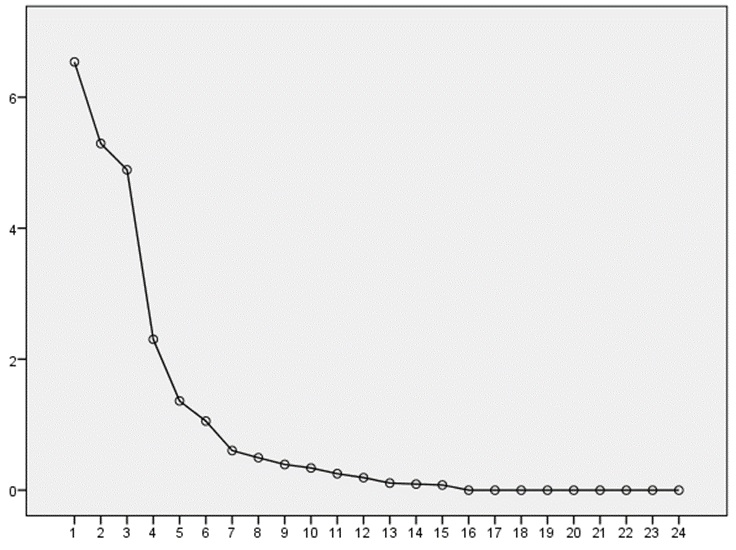
Figure 1. Katel’s landslide test
The analysis of Figure 1 reveals the most pronounced break after the third factor, which justifies the choice of three factors according to the Guttman-Kaiser criterion.
Table 5. Factor matrix after Varimax rotation
| Items | Component | ||
| 1 | 2 | 3 | |
| a20 | .865 | ||
| a5 | .865 | ||
| a12 | .779 | ||
| a1 | .675 | .330 | .448 |
| a16 | .675 | .330 | .448 |
| a23 | .675 | .330 | .448 |
| a13 | .650 | ||
| a21 | .650 | ||
| a8 | .621 | .301 | .414 |
| a24 | .616 | ||
| a6 | .602 | ||
| a22 | .894 | ||
| a14 | .894 | ||
| a15 | .894 | ||
| a7 | .818 | ||
| a18 | -.436 | -.748 | |
| a3 | -.436 | -.748 | |
| a10 | -.401 | -.652 | |
| a2 | .879 | ||
| a17 | .879 | ||
| a19 | .851 | ||
| a4 | .851 | ||
| a9 | .806 | ||
| a11 | .779 | ||
After the Varimax rotation, three factors were extracted that, according to teachers’ estimates, indicate the effects of using innovative teaching systems in physical education classes in the lower grades of elementary school (Table 5). The first factor is determined by 11 items: 20, 5, 12, 1, 16, 23, 13, 21, 8, 24, and 6; it explains 25.922% of the common variance (Table 4); it is called the effects of innovative teaching systems. The second factor is determined by 7 items: 22, 14, 15, 7, 18, 3, and 10; it explains 21.932% of the common variance (Table 4); given that items 18, 3, and 10 have a negative sign, the second factor is named student participation in teaching versus teachers’ estimates of the effects of innovative teaching systems in physical education. The third factor is determined by 6 items: 2, 17, 19, 4, 9, and 11; it explains 21.823% of the common variance (Table 4); it is called fundamental knowledge and skills of students.
The second special research hypothesis has been confirmed, which assumed that the research would identify factors that, according to teachers’ assessments, indicate the effects of innovative teaching systems in physical education classes in the lower grades of elementary school.
The results of the research on the impact of teachers’ gender and the area where the elementary school they are employed in is located on their readiness to use innovative teaching systems more in physical education classes in the lower grades of elementary school are presented based on data obtained from the Mann-Whitney U test and the calculated Pearson’s coefficient of linear correlation.
Table 6. The role and motivation of teachers in the use of innovative teaching systems
| Motivation | |
| Mann-Whitney U | 5879.500 |
| Wilcoxon W | 9119.500 |
| z | -1.474 |
| Md (male) | 80 (32.0000) |
| Md (female) | 166 (33.0000) |
| p | .140 |
| r | .009 |
The data shows (Table 6) that there is no statistically significant difference in the results of the two groups of teachers by gender Md (male) – 80 (32.0000) and Md (female) – 166 (33.0000) in their motivation to use innovative teaching systems in physical education classes in the lower grades of elementary school: U = 5879.500; z = -1.474; p = .140. A certain difference in favor of female teachers according to the calculated medians has a small effect, which is also confirmed by the calculated Pirosnov coefficient of linear correlation (r = .009).
In this way, the third specific hypothesis of the research was confirmed, which assumed that the research would determine that the gender of teachers does not significantly affect their motivation to use innovative teaching systems in physical education classes in the lower grades of elementary school.
Table 7. School area and motivation of teachers in the use of innovative teaching systems
| Motivation | |
| Mann-Whitney U | 6463.500 |
| Wilcoxon W | 9544.500 |
| z | -.173 |
| Md (urban) | 168 (33.0000) |
| Md (rural) | 78 (33.0000) |
| p | .863 |
| r | .000 |
According to the data presented in Table 7, it is observed that there is no statistically significant difference in the results of the two groups of teachers based on the area where the primary school they are employed in is located: Md (urban) – 168 (33.0000) and Md (rural) – 78 (33.0000) regarding their motivation to use innovative teaching systems in physical education classes in the lower grades of primary school: U = 6463.500; z = -.173; p = .863. The calculated Pearson correlation coefficient (r = .000) also indicates uniform assessments among teachers.
The fourth specific hypothesis of the research has been confirmed, which assumed that the area of the school where the teachers are employed does not significantly affect their motivation to use innovative teaching systems in physical education classes in the lower grades of primary school.
After confirming all specific hypotheses of the research, it can be concluded that the general assumption from which the research started has also been confirmed: that innovative teaching systems significantly contribute to the effects of physical education classes in the lower grades of primary school, but that teachers do not apply them sufficiently in their work.
- Discusion
The results of the theoretical study of the problems addressed in this research and the critical analysis presented in the paper have shown that innovations and innovativeness in classroom teaching are continuous changes and ubiquitous in classroom instruction. It has also been indicated that new, innovative, different… at the same time and necessarily does not represent an innovation if it does not contribute to a higher quality of classroom instruction and learning, as well as student participation in it (Yang & Zhang, 2025). The research results have shown that not every innovation necessarily leads to significant changes and better outcomes in the implementation of classroom instruction and student learning and participation in it. On the contrary, they have shown that innovativeness is a subjective experience of each participant in the classroom; that what is considered innovative is not the same for every participant, especially not to the same extent; and above all, that only that which is unknown and contributes to the effects of classroom instruction and student learning and participation in it is truly innovative. The findings of this conducted research are confirmed by the results of more recent studies conducted in countries with more developed practices of using innovative teaching systems in physical education (Gruno & Gibbons, 2025; Yu & Ha, 2021).
The problem of innovative teaching systems has been studied in physical education classes in the lower grades of elementary school. Physical education instruction, like the instruction of other subjects, has its specificities, as shown by didactic-methodical theory and practice, as well as the results of numerous studies (Milenović et al., 2024; Jeremić et al., 2023; Milenović & Botić, 2023; Vasilijević et al., 2023).
Starting from its essence and character, which primarily involves the psychophysical and psychosocial development of students in the lower grades of elementary school, and only then the development of their cognitive and conative abilities, it can be argued that physical education classes in the lower grades of elementary school are more specific than other classes at the level of initial education for elementary school students. Therefore, the question of the competence of teachers for the effective implementation of physical education classes in the lower grades of elementary school is raised. For the aforementioned reasons, in the Republic of Serbia, physical education classes are also conducted by subject teachers. However, it has been shown that this is not the best solution, as subject teachers are specialists in methodology and sports skills, but not in teaching methodology, which is of primary importance at the level of initial education for elementary school students since teaching is simultaneously both a profession and a discipline, for which teachers are the most competent (Tel et al., 2024; Sølvik & Gienna, 2022). Therefore, this problem will certainly be a subject of academic discussion in the future and a constant relevant issue for future research.
In the empirical part of the research, it was determined that teachers are not sufficiently familiar with innovative teaching systems. Teaching according to innovative teaching systems is planned, implemented, and evaluated using backward design, and the microstructure of the lesson, instead of the established template of lesson planning in three parts (introductory, main, and concluding; with the exception of physical education which also has a preparatory part), is realized in multiple steps, usually six to ten steps (Milenović & Botić, 2023; Ilić, 2020; Milenović, 2017; Milenović, 2013). The temporal dynamics also differ and are not as established as in traditional teaching. The role of students is significantly more pronounced in lessons implemented according to innovative teaching systems. The roles of teachers have also changed; they are no longer just lesson leaders but also motivators, accommodators, assimilators, facilitators, assistants, partners, and peers in learning for students… (Ilić, 2020). For all this, teachers have not been adequately trained, and in the Balkan countries, they are still largely insufficiently prepared to plan, implement, and evaluate lessons according to innovative teaching systems. Therefore, such results were expected. All of this places an obligation on educational authorities and teacher education faculties for a different initial training of teachers and subsequent professional development for the implementation of lessons according to innovative teaching systems. Systemic support is also needed, as well as better equipping of schools for the realization of lessons according to innovative teaching systems.
Through research, factors have been identified that, according to teachers’ assessments, indicate the effects of physical education classes in the lower grades of elementary school based on innovative teaching systems. They highly valued items that specifically indicate the effects of teaching implemented according to innovative teaching systems. These items point to the effectiveness of teaching, the success of achieving set goals and tasks, better teaching outcomes, and, above all, the well-being of all participants in classroom instruction (Milenović et al., 2024; Jeremić et al., 2023; Milenović & Botić, 2023; Vasilijevi et al., 2023b). The other two factors are determined by a roughly equal number of items that define them. The second factor is called student activity and their greater participation in teaching. Although teachers highly valued items that imply greater student involvement in teaching, immediate learning, participation in decision-making on all important issues for the realization of teaching and their learning, taking responsibility…, the negative indicators established by nearly 40% of the items that define the second factor suggest that even though teachers rated them highly, they are not entirely sure how this can be achieved in real teaching circumstances. All of this is confirmed by the results of more recent research on this and related research problems that remain relevant and interesting for investigation (Milenović et al., 2024; Jeremić et al., 2023; Milenović & Botić, 2023; Vasilijević et al., 2023). The third identified factor relates to items that indicate the acquisition of fundamental knowledge by students. These are the knowledge that students acquire through independent creative, inventive, and research work (Balažinec & Radanovic, 2025; Tekin & San, 2023; Otanga, 2021). This knowledge is relatively permanent for students and holds value for them beyond the classroom, contributing to further learning and problem-solving in everyday life and engagement in the community. Based on the analysis of each identified factor individually and their overall observation, it can be seen that they are interconnected and that there are inseparable and causal relationships between them.
The results show that there are no significant differences regarding teachers’ motivation to use innovative teaching systems in physical education classes in the lower grades of elementary school. This was shown in terms of the impact of the teachers’ gender and the area where the elementary school is located in which the teachers are employed. This does not indicate that teachers are not motivated to use innovative teaching systems in physical education, but rather that there are no differences in their assessments, which means that teachers’ motivation was not the issue of the study, but rather just one of the criterion variables. Such aligned assessments from teachers are understandable for all the reasons listed and the established research results: insufficient familiarity with innovative teaching systems; inadequate competence; specificity of the younger school age period; specificity of physical education teaching at the initial education level; insufficient equipment of schools; non-obligatory use of innovative teaching systems, and others. All of this has been established in all the previously mentioned critical analyses, especially those that deal most directly with innovative teaching systems (Milenović et al., 2024; Jeremić et al., 2023; Milenović & Botić, 2023; Vasilijević et al., 2023).
- Conclusion
The use of innovative teaching systems has been studied in this paper in the context of physical education in the lower grades of elementary school. This issue is equally important and significant, and innovative teaching systems have been studied in any other area at the level of initial education; in the higher grades of elementary school; as well as in secondary school teaching. Research results indicate that the use of innovative teaching systems can have significant effects, particularly in the domain of learning and student participation in the classroom. In such teaching, students are more valued. They participate in decision-making on all important issues of the teaching process. The majority of their time in such classes is spent exploring and practicing independently, in pairs, or in groups. The outcome of such learning is the acquisition of fundamental knowledge that is lasting for students and reaches the core of the scientific disciplines themselves. As such, they hold value for students both inside and outside the classroom and serve them in further learning and everyday actions within the community.
Starting from the highlighted importance of this issue, the Faculty of Teacher Education is expected to differently design and accredit study programs in the future that will be infused with subjects and content that will contribute to a more effective initial education of teachers. Potential authors of professional development programs for employed teachers are expected to create programs that will help teachers acquire and further strengthen their competencies for the use of innovative teaching systems. Educational authorities are expected to contribute to all of this, as mentioned. Systemic support is also necessary. Finally, teachers themselves are expected to engage as much as possible in professional training programs for the use of innovative teaching systems and to independently educate themselves in this area, as well as to apply what they have learned in teaching through the use of innovative teaching systems. Of this raises questions opened by this research that should be the focus of future investigations.
REFERENCES
Balažinec, M. & Radanović, I. (2025). Student-Scientist collaboration in the global learning and observations to benefit the environment program. Journal of Education and Learning (EduLearn), 19(4), 2065 – 2076. https://doi.org/10.11591/edulearn.v19i4.22315.
Gruno, J. & Gibbons, S. (2025). Implementing nature-based physical activity in physical and health education teacher education. Journal of Adventure Education and Outdoor Learning, 25(2), 377 – 394. https://doi.org/10.1080/14729679.2023.2243526.
Ilić, M. (2020). Didaktika. Univerzitet u Banja Luci. https://plus-legacy.cobiss.net/. [In Bosnia and Herzegovina]
Jeremić, B. S., Trbojević, A. R., Milenović, H. Ž., & Lazić, B. D. (2023). Osnaživanje pedagoških kompetencija učitelja za realizaciju sadržaja predmeta muzička kultura u uslovima nastave na daljinu. Zbornik radova Pedagoškog fakulteta, Užice, 26(25), 143 – 164. http://dx.doi.org/10.5937/ZRPFU2325127J. [In Serbian]
Markov, Z., Milenovic, H. Ž., Jeremic, B., Zecevic, R., & Pavlovic, M. (2025). Assessments of teachers and parents of children with developmental disabilities on inclusion in pre-school institutions. Pedagogika-Pedagogy, 9(2), 188 – 202.
https://doi.org/10.53656/ped2025-2.03.
Milenović, A. (2017). Razredna nastava – inovativni didaktičko-metodički modeli. Zadužbina Andrejević. ISBN 978-86-525-0294-3. [In Serbian]
Milenović, H. Ž., & Botić, M. (2023). Innovative teaching systems in teaching about nature and society at the level of initial education. DHS – Društvene i humanističke studije, 8(1), 453 – 476. [In Serbian]
Milenović, H. Ž., Vasilijević, D. N., & Botić, M. M. (2024). Professional training of teachers for the implementation of teaching about nature and society on innovative learning and teaching systems. Methodical Review: journal of philosophy of education, 31(1), 281 – 307. https://doi.org/10.21464/mo.31.1.2.
Milenović, H. Ž., Vasilijević, D. N., & Botić, M. M. (2023). Digitalne kompetencije učitelja za primenu e-udžbenika u nastavi o prirodi i društvu. Researsh in Pedagogy, 13(1), 53 – 66. https://research.rs/no24/. [In Serbian]
Milenović, Ž. (2021). Elementarna didaktika. Univerzitet u Prištini – Kosovskoj Mitrovici. https://projektimpntrrs.uf-pz.net/wp-content/uploads/2022/03/ELEMENTARNA-DIDAKTIKA-dr-Zivorad-Milenovic.pdf. [In Serbian]
Milenović, Ž. (2013). Nastavnik u inkluzivnoj nastavi. Zadužbina Andrejević. ISBN 978-86-525-0109-0. [In Serbian]
Otanga, H. (2021). Knowledge, attitudes and practices, and personality predictors of risk taking towards COVID-19 among university students in Kenya. International Journal of Psychology and Educational Studies, 8, 153 – 161. https://doi.org/10.52380/ijpes.2021.8.4.576.
Saptani, E., Rukmana, A., & Supriyadi, T. (2024). Analysis of TPACK competence of elementary school physical education teachers: A cross-sectional study. Mimbar Sekolah Dasar, 11(4), 702 – 721. https://ejournal.upi.edu/index.php/mimbar/article/view/78743.
Serikbaykyzy, G.Y., Nurbolatovich, R. S., Zhubatyrkizy, S. O., Zhanbolat, B., & Zhandos, A. (2022). Components of image competencies of future physical education teachers. Cypriot Journal of Educational Sciences, 17(5), 1715 – 1726. https://doi.org/10.18844/cjes.v17i5.7340.
Sølvik, R. M. & Glenna, A. E. H. (2022). Teachers’ potential to promote students’ deeper learning in whole-class teaching: An observation study in Norwegian classrooms. Journal of Educational Change, 23(3), 343 – 369. https://doi.org/10.1007/s10833-021-09420-8.
Tekin, Ö. G. & San, I. (2023). Teachers’ basic knowledge level of STEM education. African Educational Research Journal, 11(4), 580 – 587. https://doi.org/10.30918/AERJ.114.23.092.
Tel, H., Kelleci, M., & Kısaoğlu, Ö. (2024). Teaching and student attitudes in an online Psychiatric nursing course. American Journal of Distance Education, 38(3), 251 – 262. https://doi.org/10.1080/08923647.2022.2137355.
Trbojević, A., Jeremić, B., Milenović, H. Ž., & Lazić, B. (2025). Development of democratic culture through contents about the Roma in classroom teaching – students’ perception. Pedagogika-Pedagogy, 9(9), 1244 – 1264. https://doi.org/10.53656/ped2025-9.02.
Yang, C. & Zhang, L. (2025). The effects of online courses on academic performance: The role of innovative teaching models and teacher-student interaction. Education and Information Technologies, 30(14), 20445 – 20466. https://doi.org/10.1007/s10639-025-13578-6.
Yu, H. & Ha, T. (2021). Effective pedagogical practices in synchronous online physical education. Journal of Physical Education, Recreation & Dance, 92(9), 63 – 68. https://doi.org/10.1080/07303084.2021.1979872.
* This designation is without prejudice to status, and is in line with UNSCR 1244 and the ICJ Opinion od the Kosovo declaration of independence.