


Dr. Ivanka Karparova, Assoc. Prof.
ORCID iD: 0000-0003-4970-8838
Department of Sport
Sofia University “St. Kliment Ohridski”
Sofia, Bulgaria
E-mail: inkostova@uni-sofia.bg
https://doi.org/10.53656/ctpes-2026.IK

Pages 61-74
Abstract. This research compares the best performances of Bulgarian athletes in middle and long-distance running (the disciplines from 800 m to the marathon) with those of the world elite.
The analysis includes the 100 best results of all time in each discipline, without eliminating unique athletes. A distribution by decade was made to reflect peaks and declines.
In almost all disciplines considered, there is a concentration of the strongest achievements of Bulgarian athletes in the 1980s and 1990s, in contrast to the world elite, where most of the top results are from the last two decades, and especially in long runs – in the last few years.
The present study does not seek a direct cause-and-effect relationship with several factors that could have an impact on the stagnation in national achievements – economic and structural, but to draw attention to the potential negative role of outdated training paradigms and the lack of updating of scientific knowledge.
Keywords: national vs. world elite; performance analysis; running; sports science
- Introduction
Performance in middle and long-distance athletics competitions is a valuable indicator of human endurance. The development of modern sports science and technological progress improves athletes, regardless of whether they are in the competitive or amateur segment.
According to Zhelyazkov and Dasheva (2017), a dominant trend in major sports is the two-way relationship between scientific achievements and technical progress. For several reasons – including technological progress, the application of scientific knowledge in practice, commercialization, and the growing popularity of running – тhe results of the world elite show continuous improvement. Bulgarian runners have difficulty approaching the achievements of the 80s and 90s of the last century, although the global trend for middle- and long-distance running is different. This led us to look for different reasons, assuming that one of them is stagnation in the scientific field.
Some scientists argue that the growth of global athletic performance, driven by certain factors – advances in technology, training methods, biomechanics, pharmacology (including doping), etc., reached a plateau in the 1990s (Berthelot et al., 2015; Berthelot et al., 2019). The debate about plateau versus progress in performance in running disciplines continues, as the trend is constantly changing. In the early 21st century, several authors suggested that running performance might approach physiological or statistical limits and follow a flattened S-shaped curve (Nevill & Whyte, 2005). More recent data, however, show renewed improvements in almost all middle and long-distance running records.
These seemingly contradictory trends highlight the complex and multifactorial nature of the development of performance in endurance running. The development of performance is inevitably linked to technological progress – the boom in the production and use of running shoes and spikes has transformed athletics (Kiss et al., 2024). New running shoe technologies have played a role in historic moments and record-breaking achievements in the last few years (Hébert-Losier & Pamment, 2023). The development of portable devices has allowed laboratories to be taken outdoors, which will require ever greater improvements in their reliability and validity. While most previous measurements were performed episodically in the laboratory, smaller and more accurate sensors can now be used continuously and seamlessly in real-world situations, including competitions (Sandbakk, 2020).
Sandback et al. (2023) identify the transfer of scientific knowledge into coaching practice and collaboration between researchers, coaches, and athletes as key factors supporting future progress in endurance training. In a summary by an expert panel of 25 sports scientists, it is argued that one of the main drivers of methodological development in endurance training is the availability of appropriate scientific knowledge for coaches and athletes, together with effective integration and exchange between scientific and practical fields. Bishop et al. (2006) have summarised a panel of experts from the Australian Association of Sport and Exercise Science. The panel is about the impact of sport science research on practice and expresses the opinion that „collaboration between academic sport scientists and applied sport scientists working in the elite sporting environment on a day-to-day basis should be encouraged”. The continued development and adaptation of sports science curricula in universities and federations in many countries will lead to improved scientific knowledge among coaches, athletes, and practitioners, facilitating greater knowledge transfer within and between multidisciplinary teams (Sandbakk et al., 2023).
Opponents of the theory of methodological renewal often argue that if a given approach has worked well in the past, why should it change?
Kiely (2012, p. 248) notes that within performance environments, a commonly forwarded argument opposing innovation is an appeal to the weight of history, pointing to celebrated champions who scaled great heights using conventionally pervasive methodologies.
Is there a relationship between the relevance of scientific literature in Bulgarian textbooks, the theoretical knowledge of Bulgarian coaches, and athletes’ performance outcomes? Establishing a direct causal relationship is challenging; nevertheless, this review aims to guide the future development of applied sport science in Bulgaria.
This study hypothesizes that a possible reason for the stagnation in achievements in middle and long-distance running in Bulgaria is the discrepancy between global progress in sports science and the updating of national educational standards.
Research Objectives:
– To select the top 100 official results of Bulgarian athletes (male and female) in the middle and long distance running disciplines of track and field athletics. To use different resources, taking into account that there is no electronic version of the ranking list in which the unique athletes are not eliminated.
– To determine the number of unique athletes contributing to these performances per decade.
To compare results with those of the world elite in the same events and to identify trends. Various websites were consulted for this purpose.
– To calculate the percentage difference between the first and last performance on each list, thereby indicating the density of performances. The percentage difference between the first and 100th performance in the ranking could reflect the competitive depth of the discipline. A decreasing percentage difference indicates increasing competitive density within a given event.
– To indicate the number of cited literature sources per decade (from the beginning of the 20th century to the present) in four editions of Bulgarian books on sports training, one Russian book, and eleven foreign-language books. For comparison, some of the most cited domestic and international books and textbooks on sports training were used.
- Methodology
For the distribution of the top 100 performances of the world elite, official databases World Athletics1 and All-Time Athletics2 were used. The collection of Bulgarian results was a significant challenge, as there are no electronic statistics available. For this study, performance information was selected from various sources. As far as we know, there is only one national digital ranking on the Internet, which eliminates unique athletes. For the national results, one of the resources used is Vangelov’s statistical book (Vangelov, 2024). The website of the Bulgarian Athletics Federation3 and competition protocols were used. For convenience, unique athletes are called athletes who have multiple top achievements and dominate in a particular discipline.
The results of Bulgarian and world elite athletes are distributed by decade, depending on the year of placement. The intervals used are 1960-1969, 1970-1979, etc. The dominance of the same athletes, who are called “unique athletes” for convenience, is taken into account. In sports, it is generally accepted that one athlete can dominate for an entire decade or more. For this reason, we have taken into account both the number of results and the number of unique athletes for each decade in the top 100. The number of unique athletes gives a picture of the level of rivalry in each discipline.
- Results
Tables 1 and 2 present the results for women and men, respectively. The top 100 all-time performances for the world elite and for Bulgaria are distributed by decade. For each decade, the number of unique athletes responsible for these performances is also indicated. Table 3 presents the percentage differences between the first- and the 100th-ranked performances across all disciplines for both the world elite and Bulgaria, providing an indicator of performance density. Figures 1 – 2 visualize the number of performances for the world elite and Bulgaria by decade and by individual event.
Table 1. Decadal distribution of performances and unique athletes: world elite vs. Bulgaria (All-time top 100 – women)
| Women | 800 m | 1500 m | 5000 m | 10 000 m | half | marathon | |||||||
| Elite | BG | Elite | BG | Elite | BG | Elite | BG | Elite | BG | Elite | BG | ||
| 1970 – 1979 | performances | 6 | 53 | 31 | |||||||||
| unique athletes | 6 | 6 | 7 | ||||||||||
| 1980 – 1989 | performances | 23 | 40 | 4 | 36 | 6 | 2 | 27 | 1 | 7 | |||
| unique athletes | 13 | 9 | 3 | 4 | 6 | 1 | 10 | 1 | 2 | ||||
| 1990 – 1999 | performances | 15 | 3 | 12 | 15 | 3 | 32 | 8 | 38 | ||||
| unique athletes | 7 | 2 | 9 | 3 | 3 | 6 | 6 | 6 | |||||
| 2000 – 2009 | performances | 17 | 4 | 3 | 33 | 10 | 27 | 27 | 19 | 25 | 3 | 25 | |
| unique athletes | 7 | 2 | 2 | 1 | 5 | 4 | 21 | 7 | 8 | 1 | 3 | ||
| 2009 – 2019 | performances | 18 | 10 | 33 | 26 | 18 | 12 | 25 | 20 | 14 | 4 | ||
| unique athletes | 3 | 6 | 11 | 5 | 14 | 2 | 15 | 6 | 10 | 2 | |||
| 2020+ | performances | 21 | 71 | 57 | 26 | 50 | 10 | 75 | 47 | 83 | 26 | ||
| unique athletes | 9 | 15 | 26 | 4 | 32 | 3 | 46 | 9 | 41 | 4 | |||
Table 2. Decadal distribution of performances and unique athletes: world elite vs. Bulgaria (All-time top 100 – men)
| Men | 800 m | 1500 m | 5000 m | 10 000 m | half | marathon | |||||||
| Elite | BG | Elite | BG | Elite | BG | Elite | BG | Elite | BG | Elite | BG | ||
| 1960 – 1969 | performances | 5 | 2 | 4 | 11 | 2 | 4 | ||||||
| unique athletes | 1 | 2 | 2 | 3 | 2 | 2 | |||||||
| 1970 – 1979 | performances | 1 | 19 | 41 | 18 | 24 | 5 | 5 | |||||
| unique athletes | 1 | 7 | 7 | 6 | 8 | 3 | 3 | ||||||
| 1980 – 1989 | performances | 8 | 41 | 32 | 57 | 49 | 16 | 59 | |||||
| unique athletes | 4 | 6 | 10 | 7 | 10 | 13 | 11 | ||||||
| 1990 – 1999 | performances | 14 | 31 | 20 | 3 | 11 | 16 | 8 | 12 | 11 | 18 | ||
| unique athletes | 3 | 5 | 5 | 3 | 4 | 3 | 4 | 5 | 10 | 7 | |||
| 2000 – 2009 | performances | 6 | 23 | 22 | 29 | 6 | 9 | 1 | 12 | ||||
| unique athletes | 5 | 7 | 14 | 18 | 4 | 6 | 1 | 5 | |||||
| 2009 – 2019 | performances | 25 | 17 | 5 | 9 | 23 | 1 | 20 | 39 | 39 | 1 | ||
| unique athletes | 11 | 8 | 3 | 8 | 15 | 1 | 16 | 10 | 22 | 1 | |||
| 2020+ | performances | 46 | 4 | 40 | 17 | 58 | 5 | 40 | 3 | 74 | 20 | 60 | 1 |
| unique athletes | 16 | 3 | 16 | 2 | 25 | 1 | 20 | 1 | 39 | 8 | 35 | 1 | |
It has been observed that in certain decades, there is a complete dominance of one or a few athletes, both among the world elite and Bulgarian runners. The presence of unique athletes in the highly competitive environment of elite sport is a common, structurally inherent characteristic. A similar example is the dominance of Wilson Kipketer in the men’s 800 m, who, in the period 1990 – 1999, achieved 12 of the 14 best results. Similarly, in the men’s 1500 m, El Guerrouj dominated the discipline for a prolonged period (1990 – 2009).
It is worth noting the trend after 2020: an increasing number of athletes from outside Africa entering the top rankings, which indicates a gradual expansion of geographical representation in middle-distance running. Furthermore, from 2020 to the present, an increasing number of athletes have entered the elite level, accompanied by a decrease in the dominance of a single athlete, suggesting increased competitive depth.
In the men’s half-marathon and marathon, there are no performances in the world elite top 100 before 2000. In contrast, in Bulgaria, 34% of the top performances in the half-marathon and 86% in the marathon date back to the previous century.
In middle-distance events (800 m and 1500 m), the world elite men’s top 100 includes 29 and 43 performances, respectively, achieved before 2010. In contrast, Bulgarian male athletes have recorded only four top-100 performances in the 800 m and 22 in the 1500 m during the 21st century. A similar trend is observed among women. In the world elite, 61 of the top 100 performances in the women’s 800 m were achieved before 2010. The women’s 1500 m appears to have been a rapidly developing event over the past few years, with 71 performances in the top 100 recorded after 2020, though only three athletes achieved them.
Among Bulgarian female middle-distance runners, 96 of the top performances in the 800 m date back to the previous century, while 67 of the top performances in the 1500 m were achieved before 1990. The remaining 33 results (from the top 100 after 1990 up to the present day) belong to just one athlete.” Only one Bulgarian runner appears in the all-time top 100 world lists for middle and long-distance events – Nikolina Shtereva in the 800 m. Her performance, which remains the Bulgarian national record in the discipline, was achieved in 1976, fifty years ago.
Fig. 1 and Fig. 2 present the distribution of the number of performances by decade within the top 100 all-time women’s and men’s results (updated through December 2025) for both the world elite and Bulgaria in middle and long-distance running events (from 800 m to the marathon).
Analyzing the performances in the long-distance races (5000m and 10000m) for the world elite, a clear trend towards dominance of African runners can be observed. Also, at the end of the last century and the beginning of the current century, the achievements were often dominated by a small number of individual athletes, both men and women. However, these trends seem to have changed in recent years. In Bulgaria, the same track events show a pronounced dominance by a single athlete. Notably, in the men’s 5000 m, one athlete – Evgeni Ignatov – accounts for 58 of the top 100 performances. In the same discipline during the 21st century, only five performances appear (all by a single athlete), and between 2000 and 2020, there are no performances in the top 100. For the men’s 10 km, 86 of the top 100 performances in Bulgaria date back to the previous century (Fig. 2).
Road running events (half-marathon and marathon) have seen the fastest growth of all disciplines in athletics worldwide. A significant factor contributing to this trend is the use of technological running shoes, which have been shown in recent years to provide a measurable performance advantage. The extent to which restrictions on their use will be introduced in the future remains to be seen, but current trends show that they are increasingly influencing results. In the road disciplines (half-marathon and marathon), which are the focus of our analysis, the gap between the world elite and Bulgarian athletes is most pronounced. In the top 100 world all-time bests for the half-marathon, men and women have achieved 74 and 75, respectively, in the last five years. In the marathon, only one male and three female results in the top 100 dates from before 2010 (Fig. 2). At the time of publication of the article, there has been a change in the data for most of the middle and long distance disciplines. For example, in the men’s marathon, all but one of the top 100 elite achievements are after 2010. Since road running is developing extremely rapidly worldwide, it will not be possible to cover all the changes made from the time the article was written to its publication, but the trend presented in the analysis is preserved. All the changes that constantly occur in the world elite cannot be covered, but they are a reflection of the development trend of running.
Based on an analysis of the top 100 all-time performances, it is evident that the high-performance competition in elite sport is also reflected in the density of top performances. In the men’s marathon, the difference between the first and the last result in the top 100 all-time performances is 221 seconds, or approximately 3.07%, representing the gap between the highest achievement and the 100th-ranked performance. A similar trend of performance density is observed across other middle and long-distance events. In the half-marathon under the same conditions, the difference is 136 seconds (4.00%), for the 10,000 m – 40 seconds (2.55%), for the 5000 m – 15.4 seconds (2.1%), for the 1500 m – 3.3 seconds (1.60%), and for the 800 m – 1.72 seconds (1.71%). Thus, in the men’s world elite, there is a clearly high-performance density, which, when expressed as a percentage (the difference between the world record and the 100th-ranked performance), ranges from 1.5% to 4%. In contrast to the world elite, the Bulgarian top 100 rankings show significantly larger percentage differences (Table 3), which indicates lower competitive depth. In some disciplines, such as women’s 10000 m and men’s half-marathon, this difference exceeds 15%.
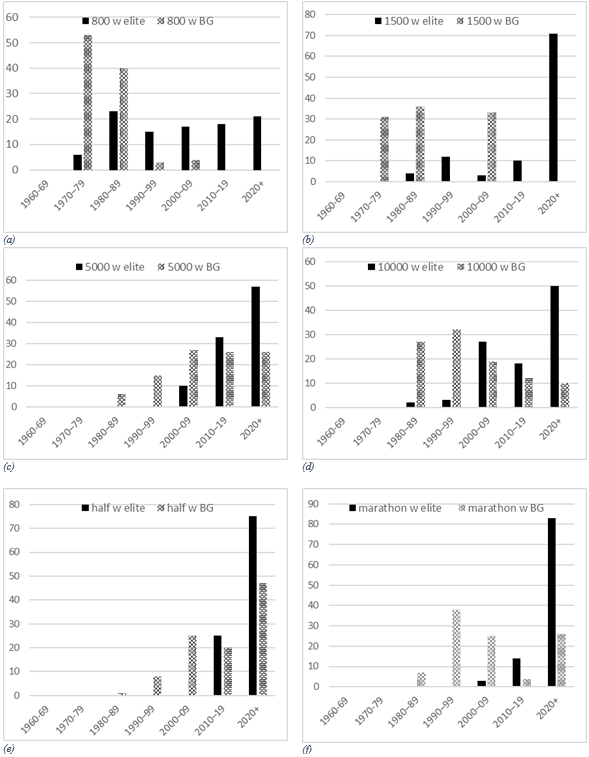
Figure 1. Decadal distribution of all-time top 100 performances in women’s middle- and long-distance track events: (a) 800 m, (b) 1500 m, (c) 5000 m, (d) 10 000 m, (e) half-marathon, (f) marathon. World elite and Bulgarian performances are shown for comparison. Dark bars represent world elite performances; light bars represent Bulgarian performances
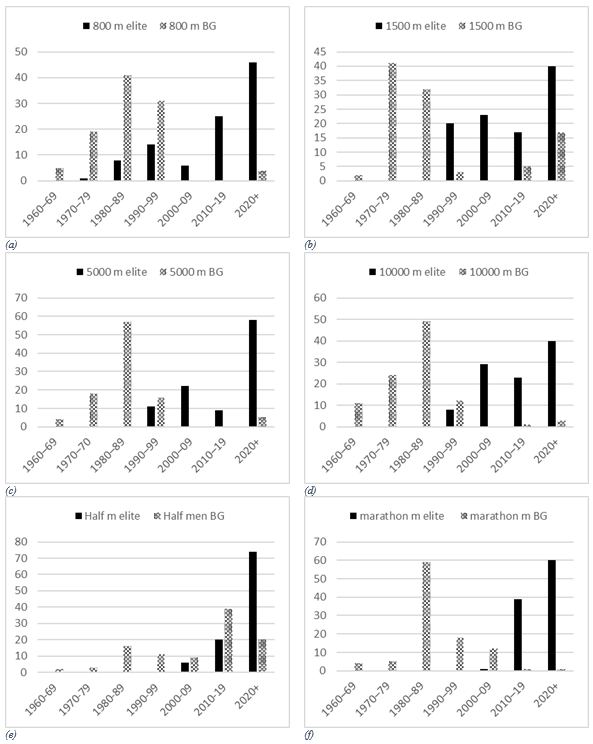
Figure 2. Decadal distribution of all-time top 100 performances in men’s middle- and long-distance track events: (a) 800 m, (b) 1500 m, (c) 5000 m, (d) 10 000 m, (e) half-marathon, (f) marathon. World elite and Bulgarian performances are shown for comparison. Dark bars represent world elite performances; light bars represent Bulgarian performances
Table 3. Percentage difference between 1st and 100th result (Top 100 all-time world elite and BG)
| Event and gender | 800 m | 1500 m | 5000 m | 10 000 m | half | marathon | |||||||
| men | women | men | women | men | women | men | women | men | women | men | women | ||
| Top 100 | Elite | 1,71 | 2,48 | 1,6 | 2,97 | 2,07 | 3,47 | 2,55 | 5,34 | 4 | 4,72 | 3,06 | 6,66 |
| BG | 2,51 | 4,48 | 2,44 | 4,92 | 6,28 | 13,05 | 6,93 | 15,43 | 15,2 | 14,74 | 7,81 | 11,83 | |
A bibliometric analysis of what is often regarded as one of the most widely used Bulgarian textbooks in sport training theory in Bulgaria – the most recent (sixth) edition of the textbook (Основи на спортната тренировка) Fundamentals of Sports Training (ОнСT6, table 4) shows that of 488 cited references, 426 originate from the 20th century. Thus, only 60 references have been published since the year 2000 (Table 4).
Table 4. Number of cited sources in 16 sports training textbooks by decade* (Note: No direct quotes from books and textbooks were used, and the analysis is based on the reference lists. Abbreviations are below the table)
| ФКС4 | ОнСТ | ИвЕС | ОнСТ3 | ОнСТ6 | HoEP | OE15 | ETSP1 | ETSP2 | EM | TEUR v1 | TEUR v2 | BfSaEM | AfR | IfR2 | DS2 | |
| 1900 – 1909 | 3 | 1 | 0 | 1 | 1 | 48 | 4 | 0 | 2 | 7 | 0 | 0 | 0 | 0 | 0 | 0 |
| 1910 – 1919 | 3 | 4 | 0 | 5 | 5 | 77 | 1 | 0 | 1 | 7 | 0 | 0 | 0 | 0 | 0 | 0 |
| 1920 – 1929 | 19 | 12 | 1 | 9 | 7 | 129 | 9 | 1 | 2 | 14 | 0 | 0 | 0 | 0 | 0 | 2 |
| 1930 – 1939 | 44 | 16 | 2 | 20 | 15 | 168 | 10 | 1 | 1 | 17 | 0 | 0 | 0 | 0 | 0 | 0 |
| 1940 – 1949 | 35 | 8 | 2 | 7 | 5 | 99 | 3 | 0 | 0 | 9 | 0 | 1 | 0 | 0 | 0 | 0 |
| 1950 – 1959 | 227 | 49 | 11 | 51 | 42 | 150 | 13 | 3 | 3 | 18 | 1 | 1 | 0 | 0 | 1 | 0 |
| 1960 – 1969 | 280 | 138 | 55 | 131 | 105 | 349 | 34 | 18 | 17 | 65 | 4 | 5 | 3 | 0 | 1 | 0 |
| 1970 – 1979 | 0 | 85 | 56 | 79 | 51 | 461 | 76 | 43 | 35 | 103 | 5 | 9 | 7 | 0 | 5 | 1 |
| 1980 – 1989 | 0 | 108 | 69 | 122 | 93 | 633 | 159 | 109 | 87 | 223 | 22 | 31 | 23 | 5 | 20 | 3 |
| 1990 – 1999 | 0 | 62 | 76 | 115 | 101 | 837 | 373 | 278 | 221 | 387 | 37 | 47 | 66 | 35 | 37 | 10 |
| 2000 – 2009 | 0 | 10 | 34 | 60 | 53 | 817 | 825 | 626 | 535 | 581 | 65 | 108 | 120 | 92 | 120 | 54 |
| 2010 – 2019 | 0 | 3 | 7 | 74 | 195 | 942 | 700 | 44 | 180 | 23 | 13 | 109 | 130 | |||
| 2020+ | 0 | 541 | 116 | 19 | 66 | |||||||||||
| Total | 615 | 495 | 307 | 605 | 488 | 3963 | 1509 | 1275 | 2389 | 2265 | 178 | 401 | 242 | 145 | 294 | 266 |
*ФКС4 – Физические качества спортсмена, 4-изд.(Zatsiorsky, 2019)
ОнСТ – Основи на спортната тренировка (Zhelyazkov & Dasheva, 2002)
ИвЕС – Издръжливостта в елитния спорт (Zhelyazkov, 2009)
ОнСТ3 – Основи на спортната тренировка, 3-изд. (Zhelyazkov & Dasheva, 2011)
ОнСТ6 – Основи на спортната тренировка, 6-изд. (Zhelyazkov et al, 2022)
HoEP – History of Exercise Physiology (Tipton, 2014)
ОЕ15 – Olympic Textbook of Science in Sport, Volume 15 (Maughan, 2009)
ETSP1 – Endurance Training Science and Practice (Mijuka, 2012)
ETSP2 – Endurance Training Science and Practice, Second Edition (Mijuka, 2023)
EM – Exercise Metabolism (McConell, 2022)
TEURv1 – Training Essentials for Ultrarunning (Koop, 2016)
1TEURv2 – Training Essentials for Ultrarunningр- Second Edition (Koop et al, 2021)
BfSaEM – Biochemistry for Sport and Exercise Metabolism (MacLaren & Morton, 2011)
AfR – Anatomy for Runners (Dicharry, 2012)
IfR2 – Injury-Free Running, Second Edition (Michaud, 2021)
DS2 – Developing Speed, Second Edition (Jeffreys, 2024)
- Discussion
The analysis of the top 100 Bulgarian all-time performances in endurance running events indicates that national achievements largely stagnated during the 1970s, 1980s, and 1990s. The problem is multifaceted; however, one possible explanation lies in the development of sport science and the availability and updating of educational and methodological literature. The concentration of the strongest male and female Bulgarian performances is in the period 1980 – 1990, which contrasts with the global trend of gradual and sustainable renewal among the world elite.
Without making a direct connection, it can be noted that the updating of local educational literature follows a similar trend to that of sports performance results. At the same time, sports science worldwide continues to develop with regular updates of textbooks and scientific resources.
It is important to emphasize that this study does not claim a direct cause-and-effect relationship. Instead, it identifies temporal peaks in elite performance and subsequent stagnation. In our opinion, these findings warrant a more in-depth study of educational and scientific policies in sport, as well as the theoretical preparation of academic and coaching staff.
The countries of the former Eastern Bloc have undoubtedly played an important role in the modern development of elite sport (De Bosscher et al., 2007). In the last decades of the 20th century, the training of Bulgarian athletes was significantly influenced by centralized training models that relied mainly on methodological approaches originating from the Eastern Bloc. This period was also characterized by state policies in support of elite sport. Since the beginning of the 21st century, an analysis of Bulgarian-language scientific and methodological literature has revealed a lack of substantial updates to textbooks, methodological manuals, and university curricula in the fields of training theory and physiology.
It is important to note here that, during the last decades of the 20th century and the first decades of the 21st century, some athletic performances were accompanied by various integrity and fairness issues. One of these relates to suspicions of systematic use of prohibited substances, likely facilitated by less effective anti-doping controls at the end of the previous millennium. The 800 m event has been considered an “ideal” discipline for anabolic effects in women’s running, and it should not be overlooked that many records were set before the establishment of the World Anti-Doping Agency (WADA) in 1999. In addition, questionable performances by Chinese female runners in middle and long-distance events during the late 20th century have been documented, some of which were later confirmed as doping cases.
Furthermore, in women’s middle-distance running, the case of Caster Semenya is worth mentioning. Semenya is biologically female, a biological woman who exhibits elevated testosterone levels. The South African runner, along with several other athletes, has maintained near-total dominance for over a decade (since the beginning of the 21st century). The Semenya case led World Athletics to introduce DSD (Differences in Sex Development) regulations that affect certain sporting events because testosterone levels above the permitted range confer a biological and unfair advantage in some women’s disciplines. The issue of gender differentiation in sport continues to be debated, with various regulations being implemented; however, this topic is beyond the scope of this study.
Countries that invest more resources in sport can create more favorable conditions for their athletes and coaches. While elite sport has traditionally received institutional attention in Bulgaria, investments in applied sports science, modernization of coach training, and local development appear relatively modest by modern international standards in our time.
A team of researchers has examined the factors influencing the development of sport at both national and international levels, emphasizing that some of these factors – such as the implementation of scientific knowledge – are subject to strategic control (De Bosscher et al., 2007).
The purpose of the descriptive bibliometric comparison (Table 4) is not to assess scientific quality but to review the updating of knowledge for some of the most widely used educational resources in sports science.
Analyzing the curves in the development of Bulgarian achievements and whether a parallel can be drawn with the updating of scientific literature in Bulgarian, they have stopped developing simultaneously.
It should be noted that the data on Bulgarian results for this research are extracted from multiple archival sources. Since there is no single digital database of national achievements, small discrepancies are possible.
Strategic investments in coach training, systematic updating of curricula, and stronger integration between scientific research and practice could represent key directions for revitalizing national achievements in endurance.
- Conclusions
Due to a combination of socio-economic, demographic, infrastructural, political, and other factors, athletics in Bulgaria – and endurance running in particular – lags behind contemporary developments observed in the world elite. Historically, the country has a tradition of endurance events and exceptional athletes who have achieved at the highest international level. Nevertheless, in nearly all analyzed disciplines, Bulgarian national records and a substantial proportion of top performances are concentrated in the 1980s and 1990s.Although it is difficult to prove a direct causal relationship between the development of scientific knowledge and the development of sports performance, this research aims to highlight the importance of integrating sports science and continuously updating training methodologies in the practice of coaches and athletes.
Acknowledgement
This research is financed by the European Union-NextGenerationEU, through the National Recovery and Resilience Plan of the Republic of Bulgaria, project No BG-RRP-2.004-000.
Special thanks to Dimitar Tsankov Dimitrov for his work on researching the bibliography of Bulgarian and foreign-language textbooks.
Special thanks to Alexander Vangelov, a Bulgarian statistician.
NOTES
- https://worldathletics.org/
- https://www.alltime-athletics.com/
- https://www.bfla.org/
REFERENCES
Berthelot, G., Sedeaud, A., Marck, A., Antero-Jacquemin, J., Schipman, J., Saulière, G., Marc, A., Desgorces, F. D. & Toussaint, J. F. (2015). Has athletic performance reached its peak? Sports Medicine, 45(9), 1263 – 1271. https://doi.org/10.1007/s40279-015-0347-2.
Berthelot, G., Johnson, S., Noirez, P., Antero, J., Marck, A., Desgorces, F.D., Pifferi, F., Carter, P.A., Spedding, M., Manoux, A. S., & Toussaint, J. F. (2019). The age-performance relationship in the general population and strategies to delay age-related decline in performance. Archives of Public Health, 77, Article 51. https://doi.org/10.1186/s13690-019-0375-8.
Bishop, D., Burnett, A., Farrow, D., Gabbett, T. & Newton, R. (2006). Sports-science roundtable: Does sports-science research influence practice? International Journal of Sports Physiology and Performance, 1(2), 161 – 168. https://doi.org/10.1123/ijspp.1.2.161.
De Bosscher, V., Bingham, J., Shibli, S., van Bottenburg, M. & De Knop, P. (2007). Sports policy factors leading to international sporting success: An international comparative study. Meyer & Meyer Sport.
Hébert-Losier, K., & Pamment, M. (2023). Advancements in running shoe technology and their effects on running economy and performance – a current concepts overview. Sports Biomechanics, 22(3), 335 – 350. https://doi.org/10.1080/14763141.2022.2110512.
Kiely, J. (2012). Periodization paradigms in the 21st century: Evidence-led or tradition-driven? International Journal of Sports Physiology and Performance 7(3), 242 – 250, https://doi.org/10.1123/ijspp.7.3.242.
Kiss, B., Waterval, N., van der Krogt, M., Brehm, M., Geijtenbeek, T., Harlaar, J. & Seth, A. (2024). Minimization of metabolic cost of transport predicts changes in gait mechanics over a range of ankle-foot orthosis stiffnesses in individuals with bilateral plantar flexor weakness. Frontiers in bioengineering and biotechnology, 12, 1369507. https://doi.org/10.3389/fbioe.2024.1369507.
Nevill, A. M. & Whyte, G. (2005). Are there limits to running world records? Medicine & Science in Sports & Exercise, 37(10), 1785 – 1788. https://doi.org/10.1249/01.mss.0000181676.62054.79.
Sandbakk, Ø., Pyne, D., McGawley, K., Foster, C., Talsnes, R., Solli, G., Millet, G., Seiler, S., Laursen, P., Haugen, T., Tønnessen, E., Wilber, R., van Erp, T., Stellingwerff, T., Holmberg, H., & Bucher Sandbakk, S. (2023). The evolution of world-class endurance training: The scientist’s view on current and future trends. International journal of sports physiology and performance, 18(8), 885 – 889. doi: 10.1123/ijspp.2023-0131. PMID: 37369366.
Sandbakk, Ø. (2020). The role of sport science in the new age of digital sport. International journal of sports physiology and performance, 15(2), 153. https://doi.org/10.1123/ijspp.2019-0934.
Zhelyazkov, T. & Dasheva, D. (2017). Osnovi na sportnata trenirovka. Bolid-Ins. [In Bulgarian]
Vangelov, A. (2024). Stote nai-dobri za 100 godini atletika v Bulgaria. E Print OOD. [In Bulgarian]