


Dr. Yavor Yordanov Valchinov
ORCID iD: 0000-0002-9269-4139
Department of Football and Tennis
Faculty of Sport
National Sports Academy “Vasil Levski”
E-mail: yvalchinov@abv.bg
https://doi.org/10.53656/ctpes-2026.YV

Pages 143-154
Abstract. This study analyses sprint running with direction changes in adolescent football players, focusing on speed, initial steps, execution technique, the influence of training methods, and individual characteristics contributing to athlete development. Both traditional and innovative training approaches are compared. To address the research objectives, the following scientific methods were used: analysis, synthesis, and interpretation of relevant literature; pedagogical observation of motor-cognitive activity; a sports-pedagogical experiment; and sports-pedagogical testing. The findings provide a foundation for developing specialised training programs to optimise technique and safety in change-of-direction sprints, with particular emphasis on preventing non-contact injuries. Integrating these programs into youth football training is expected to enhance competitiveness and minimise injury risk. The study also offers perspectives for future research in sports science and football training methodology.
Keywords: football; research; sprint; direction change; youth
- Introduction
Football requires adolescent players to develop a broad range of abilities, including technical skills, tactical intelligence, physical strength, and mental resilience. Speed, particularly the ability to change direction rapidly, distinguishes elite players. For optimal development of speed-related capabilities in 17 – 18-year-old football players, especially regarding sprint performance with direction changes, it is essential to apply practically oriented recommendations from the literature. These recommendations informed the design of this study and served as foundational reference points for the research approach:
- Create a supportive and favourable training environment.
- Prioritise the development of primary motor factors.
- Foster a positive psychological state and build resilience.
- Implement evidence-based training programs.
- Personalise the training approach to individual athletes.
- Continuously monitor players’ progress and adjust the training plan accordingly.
An analysis of the factors influencing athletes’ speed is essential. Environmental factors are primary, as the training environment significantly affects the development of speed in young football players. Ground quality, meteorological conditions, and access to appropriate equipment can all impact performance. For instance, poor turf increases resistance to movement, hindering the attainment of maximum speed (Hawkins & Sutton, 2009). Extreme climatic conditions may cause dehydration and muscular cramps, thereby reducing overall performance. Thus, providing a favourable environment is critical for optimal development of speed-related abilities in young football players. Physiological factors also exert substantial influence. Key physiological components contributing to speed development in 17 – 18-year-old football players include muscular strength, flexibility, running technique, and anaerobic capacity. Staykov (2018) examines the interrelationships between physical and technical indicators, demonstrating that comprehensive development of fundamental physical qualities is necessary to enhance physical fitness. Ignatov & Atanasov (2017) report that improving players’ physical readiness and optimising the training process leads to greater homogeneity in physical condition. Muscular strength is required for generating the power necessary for rapid acceleration and sprinting (Hudson et al., 2021). Flexibility supports efficient movement, minimises energy loss, and enhances explosiveness (Behm & Chaouachi, 2011). Proper running technique is crucial for football performance, as it enables players to maintain stability, reduce drag, and maximise speed. Noakes (2002) observes that proper running technique significantly improves movement efficiency and reduces injury risk. Anaerobic capacity is also vital, as it enables the body to deliver high energy output during short, intense efforts typical of football. McArdle et al. (2010) emphasise that the anaerobic system is essential for intensive, short-duration activities characteristic of many sports, including football.
Psychological factors are also significant in the development of speed among young football players. Fear of injury, lack of confidence, stress, and pre-competition anxiety can all negatively impact performance. Weinberg & Gould (2019) highlight that psychological factors can substantially influence athletic performance, particularly in young athletes. Hanin et al. (2016) report that stress and anxiety disrupt coordination and concentration, resulting in decreased movement efficiency and slower reaction times. Lack of confidence is another barrier; Bandura (1997) identifies self-efficacy as a key component of sport performance, with higher self-efficacy linked to improved motivation and resilience to stress. In contrast, a positive mindset, strong motivation, and sustained focus can help players overcome these challenges and improve their speed (Howland, 2006). Therefore, the integration of mental-skills training and resilience-building strategies should be a core component of speed-development programs.
Collectively, these authors regard speed as a fundamental motor quality enabling individuals to perform movements efficiently and precisely within a specified time interval.
Every motor activity is characterised by specific conditions in which speed functions as the motor quality enabling individuals to perform comprehensive or discrete movements in the shortest possible time, considering the specifics of the task. Several authors have examined this concept: Kimura et al. (2021) define speed as an important factor in assessing coordination, proposing that speed is related to the ability to perform movements efficiently and accurately within a given time frame. Olsen et al. (2012) discuss speed as a key component of agility, viewing speed as a measure of the effectiveness of the motor response, reflecting the ability to produce fast and accurate movements. Bradly & Grenville-Cleave (2018) define speed as “the rate at which a given event or process progresses over time,” highlighting the importance of speed in determining agility and other motor qualities. Bojkowski et al. (2022), in a literature review on coordination, emphasise the role of speed in performing complex motor tasks, suggesting that speed is a critical factor for effective and precise execution of these tasks. Barlett (2014) similarly describes speed as “the ability to produce movements of a given magnitude in the minimum time,” underscoring its role in shaping agility and related motor abilities Collectively, these authors regard speed as a fundamental motor quality enabling individuals to perform movements efficiently and precisely within a defined time frame. The concept of speed is often discussed alongside other motor qualities, such as agility, when analysing an individual’s ability to execute precise and adaptive movements at maximum speed. In this context, several authors have explored the concept of quick-start movements. It is assumed that the onset speed of movement is a decisive factor influencing the overall movement speed and should therefore be considered in motor-performance analysis. Allen & Laborde (2014), in The Role of Personality in Sport and Physical Activity, present movement‑initiation speed as a distinct motor quality, emphasising the importance of rapid initiation of movements for achieving high levels of efficiency and performance in various sports and motor activities. Eden et al. (2022), in Principles of Human Movement Augmentation and the Challenges in Making It a Reality, describe movement initiation speed as “the ability to initiate movements of a given magnitude in minimal time”, highlighting its critical role in determining agility and other motor qualities.
Based on the preceding analysis, the objective of this project is to study and analyse sprinting with changes of direction in 17 – 18-year-old football players, and to formulate conclusions and recommendations derived from the collected data.
To accomplish this objective, we set the following research tasks:
- Examination, analysis and interpretation of the problem as presented in the literature.
- Selection of a test battery to determine the level of sprinting ability with changes of direction in football players aged 17 – 18 years.
- Development of a training model for the improvement of sprinting with changes of direction in the studied age group.
- Drawing grounded conclusions and recommendations based on the study and further analysis and interpretation of the data.
The study group represented 29 competitive football players from PFC Lokomotiv Sofia and the Academy for Football Development. The experimental group comprised players from the Academy for Football Development, while the control group comprised players from PFC Lokomotiv Sofia.
- Research Methodology
Four core factors have guided the development of the training model in line with the study objective:
– First, the nature of football as a game, with its rapidly changing environment, and the need for constant quick decision making which results in accurate and timely actions. Speed, of all kinds, with or without the ball, was a point of emphasis.
– Second, we took into account the age of the players, as along with the selection of appropriate methods and means for implementing suitable training approaches and techniques for this development stage.
– Third, a limiting factor was the inability of players to train as a homogeneous group according to our intended scheme due to their school commitments occurring at different times of the day. Additionally, intermediate match rounds, such as the so-called English week, further complicated the training consistency.
– Fourth, considerations related to the available material base were also important. Some exercises require preliminary preparation and precise layout design of the training tracks, as tenths of a second can critically influence the development of players’ speed abilities.
Based on these considerations, we prepared four tests for the purpose of the study:
- 20-meter sprint with a 5-meter 45-degree change of direction, starting from a walking stance without a ball.
- 20-meter sprint with a 5-meter 45-degree change of direction, starting from a light jog without a ball.
- 20-meter sprint with a 5-meter 45-degree change of direction, starting from a walking stance with a ball.
- 20-meter sprint with a 5-meter 45-degree change of direction, starting from a light jog with a ball.
- Analysis of the Results
Table 1. Comparative analysis results for the test: “20 m sprint with a change of direction of 5 m at 45º from walking without a ball”
| Indicators | n | First testing | Second testing | Change | |||||
| X̅ | S | X̅ | S | d | d % | T | P(t) | ||
| EG | 16 | 4,68 | 0,24 | 4,26 | 0,19 | -0,42 | 8,97 | 8,072 | 100 |
| CG | 13 | 4,75 | 0,27 | 4,78 | 0,35 | 0,03 | 0,63 | -0,334 | 25,6 |
| d | -0,07 | -0,52 |
|
||||||
| t | -0,77 | -5,22 | |||||||
| P(t) | 55,2 | 100 | |||||||
| Cohen`s d | 0,274 | 1,846 | |||||||
Data processing for the test “20 m sprint with a 5 m 45-degree change of direction from walking without a ball” is presented in Table 1 and Figure 1. Analysing the performances of the participants from the experimental group (EG) and control group (CG), we observe an improvement in the mean performance of the boys in the EG, contrasted with a poorer final mean performance in the CG. Before the experimental phase, the tested players in the EG achieved a mean of 4.68 s, and in the second test they improved to 4.26 s, representing an absolute gain (d) of 0.42 s and a relative gain of (d%) = 8.97%. This difference can be regarded as significant, given the test’s guarantee of statistical power with P(t) = 100%.
By contrast, changes among the competitors in the control group are markedly different. Their baseline of 4.75 s increased to 4.78 s on retesting. This decline in the team’s mean performance by 0.63% is not statistically significant at the P(t) = 25.6% level, as indicated in Table 1.
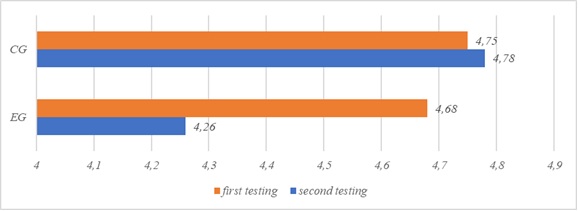
Figure 1. Mean performance values on the test “20-m sprint with a change of direction at 5 m at a 45° angle from walking without a ball”
Analysis of performance differences between the EG and CG indicates that, as shown in the figure, athletes in the EG demonstrated better baseline results, achieving 4.68 s compared to 4.75 s for the CG. This difference should be considered insignificant, given the guarantee probability P(t) = 55.2%, as presented in Table 1. After the targeted training intervention, the difference increased in favor of the EG, reaching 0.52 s in the post-test. This improvement is significant, supported by the guarantee probability P(t) = 100% from the second testing. Considering the Cohen’s d value of 1.846 at the end of the study, the improvement in mean performance of the experimental group can be attributed to the specific training stimuli applied within the developed model.
Table 2. Comparative analysis results for the test “20-m sprint with a change of direction at 5 m at a 45° angle from light running without a ball”
| Indicators | N | First testing | Second testing | Change | |||||
| X̅ | S | X̅ | S | d | d % | t | P(t) | ||
| EG | 16 | 4,47 | 0,26 | 4,19 | 0,21 | -0,28 | 6,26 | 9,574 | 100 |
| CG | 13
|
4,52 | 0,21 | 4,55 | 0,16 | 0,03 | 0,66 | 1,543 | 41 |
| D | -0,05 | -0,36 | |||||||
| t | -0,51 | -5,24 | |||||||
| P(t) | 38,8 | 100 | |||||||
| Cohen`s d | 0,212 | 1,928 | |||||||
The results presented in Table 2 and Figure 2 characterize the performance on the administered test. Comparing the achievements of the players from the CG and EG, we observe a higher mean performance in the EG, in contrast to the lower, weaker final mean performance of those in the CG. During the initial testing, the participants in the EG achieved an average result of 4.47 s, which improved to 4.19 s in the second testing. This represents an absolute improvement of 0.28 s and a relative improvement of d% = 6.26%. This difference can be considered significant, given the guarantee probability P(t) = 100%. The changes in the CG differ substantially. Their initial mean value of 4.52 s deteriorated to 4.55 s. This decline in the team’s mean performance by 0.66% is statistically insignificant, with a 41% probability, as presented in Table 2.
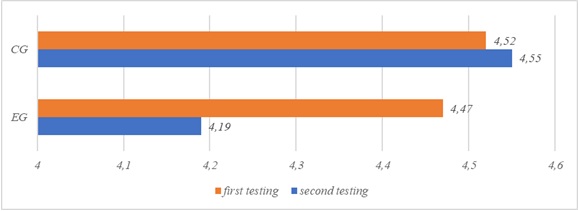
Figure 2. Mean performance values on the test “20-m sprint with a change of direction at 5 m at a 45° angle from light running without a ball”
When we examine and evaluate the performance disparities between the groups under study, we find that the players from the EG had better baseline results (4.47 s against 4.52 s attained by the athletes in the CG), as shown in Figure 2. This difference can be considered insignificant, given the guarantee probability P(t) = 38.8%. Following the implementation of targeted training aimed at improving sprint performance with a change of direction, the observed difference once again favours the athletes from the EG reaching 0.36 s. This difference is confirmed as statistically reliable based on the guarantee probability P(t) = 100%
Table 3. Results from the comparative analysis of performance on the test “20-m sprint with a change of direction at 5 m at a 45º angle from dribbling with the ball.”
| Indicators | n | First testing | Second testing | Change | |||||
| X̅ | S | X̅ | S | d | d % | t | P(t) | ||
| EG | 16 | 5,22 | 0,40 | 4,87 | 0,37 | -0,35 | 6,70 | 7,413 | 100 |
| CG | 13 | 5,56 | 0,47 | 5,40 | 0,44 | -0,16 | 2,88 | -0,330 | 85,1 |
| d | -0,34 | -0,53 | |||||||
| t | -2,12 | -3,55 | |||||||
| P(t) | 95,7 | 99,9 | |||||||
| Cohen`s d | 0,779 | 1,304 | |||||||
The calculated test results are presented in Table 3 and Figure 3. Analysing the results of the boys in both groups, we should note an improvement in the mean performance of the players in both groups. During the initial testing, the athletes from the EG achieved an average of 5.22 s, while in the second testing they recorded 4.87 s, which represents an absolute increase of 0.35 s and a relative one of d% = 6.70%. We may characterise this difference as substantial, given the value of the confidence probability P(t) = 100%.
The changes observed in the players from the CG are similar. Their initial performance of 5.56 s improved to 5.40 s at the follow-up test. This improvement in the group’s mean result is 0.16%, but it is statistically insignificant, considering the confidence probability P(t) = 85.1%, as indicated in Table 3.
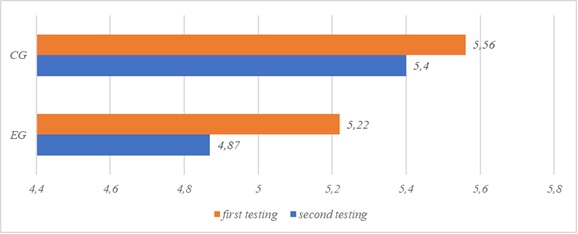
Figure 3. Mean values of performance in the test “20-m sprint with a change of direction at 5 m at a 45° angle from ball dribbling”
When comparing the differences in the performance of the tested groups, we observe a better initial result for the athletes from the EG – 5.22 s. The result of the boys from the CG is 5.56 s. This difference can be characterised as significant, considering the value of the confidence probability P(t) = 95.7%. In the second testing, we record a difference of 0.53 s in favour of the football players from the EG. This difference is confirmed at the required level of statistical reliability, as indicated by P(t) = 99.9%. The improved performance of the players from the EG and the mean difference achieved in comparison with the athletes from the CG are further supported by the value of the statistical indicator Cohen’s d, which in the second testing is 1.304.
Table 4. Comparative analysis results for the test “20-m sprint with a change of direction at 5 m at a 45° angle from light running with the ball”
| Indicators | n | First testing | Second testing | Change | |||||
| X̅ | S | X̅ | S | d | d % | t | P(t) | ||
| EG | 16 | 5,13 | 0,46 | 4,77 | 0,50 | -0,36 | 7,02 | -9,282 | 100 |
| CG | 13 | 5,63 | 0,35 | 5,65 | 0,35 | 0,02 | 0,36 | -3,521 | 25,3 |
| d | 0,5 | -0,88 | |||||||
| t | -3,23 | -5,36 | |||||||
| P(t) | 99,7 | 100 | |||||||
| Cohen`s d | 1,223 | 2,039 | |||||||
The results of the test are presented in Table 4 and Figure 4. Analysing the performance of the players from the EG, an improvement in their mean achievement is observed compared to the lower final mean result of the athletes from the CG. The EG participants’ average time was 5.13 seconds in the first test, but it dropped to 4.77 seconds in the follow-up test, indicating a difference of 0.36 seconds and a relative improvement of d% = 7.02%. This difference can be deemed significant, as indicated by the confidence probability value P(t) = 100%.
On the other hand, the players from the CG showed a decline in their performance. Their initial mean result of 5.63 s deteriorated to 5.65 s during the second assessment. This decrease of 0.02% in the average performance is statistically justified and supported by the confidence probability value P(t) = 25.3%, as shown in Table 4.
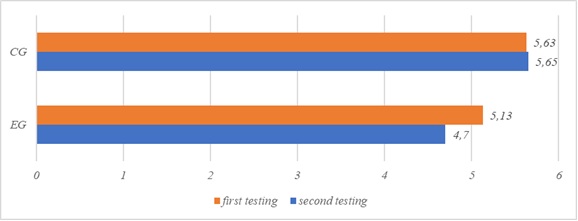
Figure 4. Mean performance values on the test “20-m sprint with a change of direction at 5 m at a 45° angle from light running with the ball”
When comparing and analysing the performance differences between the examined groups, we note the better baseline result of the individuals in the EG, which amounted to 5.13 s. The result of the football players from the CG is 5.63 s. This difference may be defined as significant, considering the confidence probability value P(t) = 99.7%. In the second assessment, the difference reaches 0.88 s, favouring the athletes from the EG. The confidence probability of P(t) = 100% in Table 4 indicates that this difference is verified at the necessary level of reliability.
- Discussion
In the test “20-m sprint with a change of direction at 5 m at a 45-degree angle,” performed in four variants, the results demonstrate the positive impact of the specific training means applied during the training process. The relative improvement between the first and second testing sessions in all four tests of the experimental group ranges from 6.26% to 8.97%, compared to 0.36% to 2.88% in the control group. The indicated percentage improvements in the experimental group across all four tests are supported by a confidence probability level of P(t) = 100%, whereas the reported improvements in the control group do not possess the required level of statistical reliability. Moreover, the influence of the applied training methods on the performance of the experimental group is evident. The values of Cohen’s d for the individual comparisons between the two groups are 1.846, 1.928, 1.304, and 2.039, indicating very large differences between the groups.
Considering that in some of the tests the control group initially demonstrated better baseline values but later showed a decline in performance, and given that the only difference in the training methodology concerned the means and methods used for developing speed, these differences may be attributed entirely to the effects of the implemented training programme.
Our research allowed us to identify several noteworthy tendencies:
- Based on the literature review, several key factors contributing to improved change‑of‑direction sprinting in football players can be outlined. These include the state of the motor qualities strength and flexibility, the athletes’ level of technical proficiency, and consequently, their mental preparation. As leading methods and approaches, particular emphasis should be placed on those aimed at developing explosive strength, with plyometric training being the most prominent representative. Additionally, incorporating sport‑specific approaches into the training process produces a further positive effect. In this regard, the use of realistic game situations is especially valuable, as it helps refine the relationship between motor skills and physical qualities—in this case, the interaction among sport technique, speed, and explosive strength.
- The motor tests clearly revealed a considerable reserve in the explosive strength and speed of the examined athletes. Given the direct impact of these two motor qualities on competitive performance, we believe that targeted measures and systematic, long-term work toward their development should be implemented throughout childhood and adolescence.
- Further research is required to determine the optimal balance among different types of training – such as plyometric training, strength training, and high‑intensity interval training – and to examine their combined effect on the overall performance of football players.
We may make the following recommendations for coaches engaged in youth football academies based on the assessment and analysis of our research data:
- Include plyometric drills and workouts in the training regimen of athletes aged 17 to 18 that are designed to improve change-of-direction technique, response time, acceleration, directional changes, and the capacity to avoid an opponent. Optimizing the first step and minimizing the counter step require particular attention. These types of exercises strengthen the neuromuscular system’s reactivity and muscular explosiveness, which leads to greater force production and muscle-fiber activation.
- Incorporate high-intensity interval training, which can significantly improve the speed capabilities of football players in this age category, in addition to training sessions aimed at increasing the various manifestations of physical strength.
- Keep an eye on individual-level strategies to enhance athletes’ performance outcomes, optimize training impacts, and adapt training regimens.
- Conclusion
Discussions about increasing the speed of 17 – 18-year-old football players, especially with regard to change-of-direction sprinting, emphasizes the need of comprehending the efficacy of various training techniques. Coaches and sport scientists can help youth athletes achieve their full potential and improve their on-field performance by regularly evaluating players’ progress and modifying training plans accordingly. Future studies should keep looking at the best ways to improve youth football players’ speed, with an emphasis on evidence-based techniques that maximize both performance and long-term athletic development.
References
Allen, M., & Laborde, S. (2014). The role of personality in sport and physical activity. Current Directions in Psychological Science, 23(6). https://doi.org/10.1177/0963721414550705.
Bandura, A. (1997). Self-efficacy: The exercise of control. W. H. Freeman.
Barlett, R. (2014). Analysing human movement patterns: Analysing human movement patterns (3rd. ed.). Routledge. https://doi.org/10.4324/9781315889504.
Behm, D., & Chaouachi, A. (2011). A review of the acute effects of static and dynamic stretching on performance. European Journal of Applied Physiology, 111, 2633 – 2651. https://doi.org/10.1007/s00421-011-1879-2.
Bojkowski, L., Kalinowski, P., Śliwowski, R., & Tomczak, M. (2022). The importance of selected coordination motor skills for an individual football player’s effectiveness in a game. International Journal of Environmental Research and Public Health, 19(2), 728. https://doi.org/10.3390/ijerph19020728.
Bradly, A., & Grenville-Cleave, B. (2018). Positive psychology in sport and physical activity. Routledge.
Eden, J., Bräcklein, M., Ibáñez, J., Barsakcioglu, D. Y., Di Pino, G., Farina, D., Burdet, E., & Mehring, C. (2022). Principles of human movement augmentation and the challenges in making it a reality. Nature Communications, 13, 1345. https://doi.org/10.1038/s41467-022-28725-7.
Hanin, Y. L. Hanina, M., Šašek, H., & Kobilšek, A. (2016). Emotion-centered and action-centered coping in elite sport: Task execution design approach. International Journal of Sports Science and Coaching, 11(4). https://doi.org/10.1177/1747954116654782.
Hawkins, E., & Sutton, R. (2009). The potential to narrow uncertainty in regional climate predictions. Bulletin of the American Meteorological Society, 90(8), 1095 – 1108. https://doi.org/10.1175/2009BAMS2607.1.
Howland, J. (2006). Mental skills training for coaches to help athletes focus their attention, manage arousal, and improve performance in sport. Journal of Education, 187(1). https://doi.org/10.1177/002205740718700105л
Hudson, J., Phelan, M. M., Owens, D. J., Morton, J. P., Close, G. L., & Stewart, C. E. (2021). “Fuel for the damage induced”: Untargeted metabolomics in elite rugby union match play. Metabolites, 11(8), 544. https://doi.org/10.3390/metabo11080544.
Ignatov, G., & Atanasov, E. (2017). Control and assessment of the physical capabilities of the student football teams of Sofia University and the National Sports Academy. Research in Kinesiology, 45(1), 45 – 48.
Kimura, A., Yokozawa, T., & Ozaki, H. (2021). Clarifying the biomechanical concept of coordination through comparison with coordination in motor control. Frontiers in Sports and Active Living, 3. https://doi.org/10.3389/fspor.2021.753062.
McArdle, W. D., Katch, F. I., & Katch, V. L. (2010). Exercise physiology: Nutrition, energy, and human performance. Lippincott Williams & Wilkins.
Noakes, T. D. (2002). Lore of running (4th ed.). Human Kinetics.
Olsen, G., Malone, T., & Smith, J. (2012). Coordination theory and collaboration technology. Psychology Press.
Staykov, N. (2018). Study of the psychological preparedness of futsal players. Sport i nauka, 62(3), 139 – 149. [In Bulgarian]
Weinberg, R. S., & Gould, D. (2019). Foundations of Sport and Exercise Psychology (7th ed.) Human Kinetics.

Свързани статии:
 Control and Assessment of the Physical Capabilities of Football Players
Eccentric Hamstring Strength and Inter-limb Asymmetry in Non-professional Football Players
State and Barriers to the Digitalization of Small and Medium-Sized Enterprises in Bulgaria
Long-term Trends in Endurance Running Performance in Bulgaria: Comparison with the World Elite and the Patterns of Sport Science Knowledge


