


Dimityr Panchukov
University of National and World Economy, Sofia, Bulgaria
Kaloyan Dimitrov
University of National and World Economy, Sofia, Bulgaria
https://doi.org/10.53656/igc-2025.25

Pages 273-282
Abstract. The accelerated development of digital and emerging technologies is having a transformative impact on business and organizations, necessitating new approaches to leadership that consider human factors. The aim of this paper is to provide a comprehensive description and analysis of transformational leadership theories. The present study explores a number of theoretical aspects in the context of the fifth industrial revolution. The qualitative desk research methodology encompasses a thorough literature review and analysis of relevant sources on the subject. This facilitates the presentation and discussion of pivotal aspects of transformational leadership. In conclusion, the paper highlights the critical importance of a transformational leadership style in the context of Industry 5.0.
Keywords: leadership theory; Industry 5.0; transformational leadership; leadership style; human development
JEL: A22, I25, O31
Introduction
The literature review on transformational leadership and its necessity in the evolving Industry 5.0 era is a compelling area for exploration. Avolio et al. (2009) emphasize the importance of examining leadership in the context of technological advancements, particularly in terms of how e-leadership can transform traditional roles within virtual environments. Their work emphasizes the need for a holistic understanding of leadership dynamics, which is crucial as industries increasingly adopt advanced information technologies. This perspective provides a foundation for evaluating how transformational leadership can adapt to, and flourish in, environments characterized by rapid technological change and collaboration.
This conceptual paper explores the critical intersection of transformational leadership theory and the emerging Industry 5.0 paradigm. The aim of this study is to provide a comprehensive theoretical analysis, arguing for the necessity of transformational leadership in an industrial era that prioritizes human-centricity, sustainability, and resilience. Employing a qualitative desk research methodology, the study synthesizes and critically reviews extant literature on transformational leadership – including its core components of idealized influence, inspirational motivation, intellectual stimulation, and individualized consideration (the “Four I’s”) – and the foundational principles of Industry 5.0.
Brief overview of transformational leadership theory
There are many ways to complete the sentence: “Leadership is …”. In fact, as Ralf Stogdill (1974) points out in his study, “there are almost as many different definitions of leadership as there are people who have tried to define it”. Although everyone intuitively knows what these words mean to him or her, leadership can have a changing meaning for different people and periods. In this regard, transformational leadership theories have many supporters among business managers because they reflect the desire of leaders to change outdated management models in business organizations and make them competitive in the market (Sterev & Milusheva, 2024; Idriz, 2025).
Transformational Leadership
The concept of transformational leadership has its roots in the work of sociologist James V. Downton (1973), who is credited with coining the term. The theory was significantly advanced and popularized shortly thereafter by leadership scholar James Burns (1978). In his seminal work, Burns defined transformational leadership as a collaborative process where “leaders and followers help each other advance to a higher level of morality and motivation”. The philosophy of transformational leadership is predicated on motivation and the emotional connection between the leaders and their followers. This emerging form of leadership emphasizes the cultivation of followers’ professional and personal growth, in addition to fostering organizational development (Stewart, 2006). According to this theory, human beings develop and work more actively and effectively through positive stimulation of internal motivation rather than through rewards or punishments.
According to Peter Northouse (2025), transformational leadership is “a process in which a person engages with others and creates a relationship that raises the level of motivation and morale in both the leader and the follower”. He argues that transformational leaders motivate followers to exceed expectations by: (1) raising followers’ awareness of the importance and value of certain idealized goals, (2) getting followers to transcend their own self-interest for the sake of the team or organization, and (c) moving followers to address higher-level needs.
Indeed, transformational leadership emerges when a compelling vision of the future is articulated, one that profoundly excites and persuades its adherents. A critical element in this regard is the role of the leader as the visionary, who, through their enthusiasm and passion, inspire others to follow. According to Lewis et al. (2017), transformational leaders motivate their followers in a way that allows them to transcend their personal interests through their work.
According to Bernard Bass (1999), transformational leadership is dynamic and moral in nature, as it promotes human development, values, and ethical behavior. The author of this study posits that transformational leadership is characterized by a process in which leaders and followers engage in active cooperation on the path to achieving shared objectives. In this paradigm of leadership, the leader executes educational functions and orchestrates organizational transformation, thereby influencing the motivations and objectives of their subordinates and fostering unity among individuals to achieve elevated objectives. Consequently, others begin to act more actively and effectively. Bass further posits that „this leadership is universally applicable, and that the transformational leader inspires his followers to transcend their own interests for the good of the organization“.
Avolio (2010) conducted a critical analysis of Bass’s theory of transformational leadership, examining the four factors more commonly referred to as the “Four I’s”:
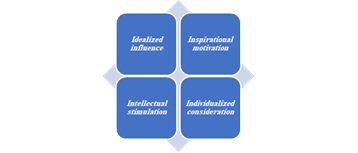
Figure 1. The Four Essential Components of Transformational Leadership
– Idealized influence – or leadership based on charisma. The leader tries to be a role model that followers want to emulate. They show persistence and determination in achieving goals, take responsibility for their actions, and demonstrate firm belief in their vision. Leaders sacrifice their own interests for the benefit of others and share in common successes. Followers feel emotionally connected to the leader, describing them as charismatic and demonstrating great trust in them.
– Inspirational motivation – or leaders inspire others by motivating them with optimistic visions of the future. They encourage their subordinates to express their expectations and efforts to achieve the goal. They reduce the complexity of problems by boiling them down to key issues and use simple language when presenting the organization’s mission. The response of followers is a willingness to make additional efforts to accomplish the mission. The leader’s transformational behavior provides meaning and challenge to inspire followers to participate in goals that transcend their personal interests.
– Intellectual stimulation – or leaders encourage followers to use their imagination, question routine methods of action, seek new approaches to problems, and learn from mistake.
– Individualized consideration – or leaders are interested in the personal and professional development of their followers. They are interested in the needs of their subordinates and provide them with opportunities for development and challenges, delegating complex tasks to them. In this way, followers improve and develop their competencies and will be prepared to participate in new initiatives.
In general, this theory posits that leadership is a process through which an individual engages with others, thereby establishing a connection that results in increased motivation and morale among followers and leaders alike (Morton, 2012). The concept has been frequently compared to the theory of charismatic leadership, which posits that leaders who possess specific qualities, including trust, extroversion, and clearly defined values, are most effective in motivating their followers. The crux of transformational leadership lies in leaders’ attentiveness to the needs and motivations of followers, thereby facilitating their pursuit of optimal self-actualization. Furthermore, transformational leadership is characterized by the ability of leaders to initiate, develop, and implement significant changes within an organization. Despite the extensive research conducted on numerous leadership theories, transformational leadership has emerged as the most widely endorsed leadership theory over the past two decades.
The Full-range Leadership Model
A theoretical framework that also describes the idea of transformational leadership is the so-called “Full-Range Leadership Model” (Avolio & Bass, 2004). The original conception of this model was attributed to Bernard Bass; however, subsequent development and refinement were conducted in collaboration with Bruce Avolio. The model posits that the constituent leadership sub-styles are not mutually exclusive, but rather, they are complementary components. The authors posit that the efficacy of leadership is amplified through the implementation of transactional leadership techniques and attains its zenith when it assumes a transformational nature. The model is predicated on three fundamental leadership styles: (1) Transformational leadership, (2) Transactional leadership (including management-by-exception and contingent reward), and (3) Laissez-Faire leadership.
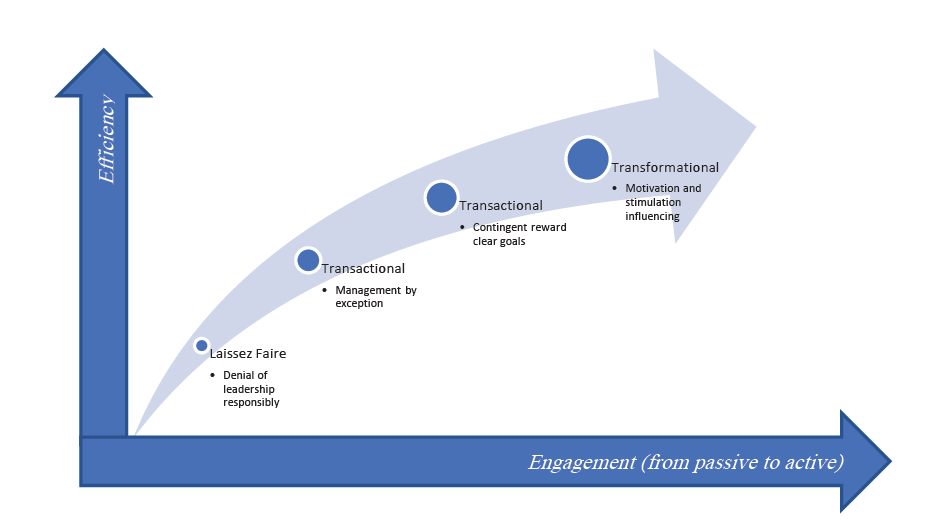
Figure 2. Full-range leadership model by Avolio & Bass (2004)
A substantial period of research has demonstrated that the implementation of transformational leadership has a favorable effect on a variety of organizational and personal outcomes. This encompasses aspects such as follower satisfaction, organizational commitment, and in-role performance. Transformational leaders exert influence over their subordinates by motivating and inspiring them to achieve organizational goals and imagine appealing future outcomes. Critical reviews of meta-analyses indicates that transformational leadership exhibits robust positive associations with various outcomes, including leader effectiveness, follower satisfaction with communication and collaboration, organizational commitment, and job performance (Antonakis et al
A considerable body of research has centered on individual differences, encompassing factors such as leader personality (Ross & Offermann, 1997), emotions (Rubin et al., 2005), emotional intelligence (Mandell & Pherwani, 2003), and creativity (Shin & Zhou, 2003). However, it must be noted that individual differences alone do not provide a comprehensive overview of the subject. Consequently, numerous other dependencies have been the focus of study and have been proven to exist, including job satisfaction (Barling et al., 2000); trust (Bono & Judge, 2003); commitment (Martin & Bush, 2006); employee motivation (Bono & Judge, 2003); empowerment (Martin & Bush, 2006); the work environment as a social context (Bommer et al., 2004); and organizational culture (Shivers-Blackwell, 2006). A substantial body of research indicates that transformational leaders must be situated in an optimal context to achieve their objectives.
However, Thomas (2008) advanced an opposing concept of leadership. Their research suggests that a leader’s capacity to glean insights from challenging circumstances is pivotal in cultivating the competencies essential for exceptional leadership. The two scholars posit that leadership behaviors frequently emerge as a consequence of “unplanned experiences that would transform and become sources of their instinctive leadership qualities”.
About the Industry 5.0 Paradigm
The concept of Industry 5.0 signifies a substantial metamorphosis within the industrial milieu, constituting a purpose-driven reaction to the constraints and challenges inherent in its antecedent, Industry 4.0. Although Industry 4.0 was predominantly a technology-centric revolution that prioritized digitalization, automation, and efficiency, Industry 5.0 signifies a substantial philosophical shift (Alves et al., 2023). This novel paradigm transcends the conventional objectives of industry, namely efficiency and productivity, thereby underscoring its societal contribution. The fundamental challenge that Industry 5.0 aims to address is the potential for dehumanization in a progressively automated world, by prioritizing the well-being of the worker as a central tenet of the production process. This is not merely a conceptual shift but, as some sources describe it, a “tectonic shift” in how industry contributes to the well-being of communities, the environment, and the planet (Bucci et al., 2025). The paradigm argues that technology should not replace humans but rather collaborate with them, leveraging uniquely human skills like creativity, critical thinking, and craftsmanship. The contemporary industrial epoch is supported by three fundamental pillars:
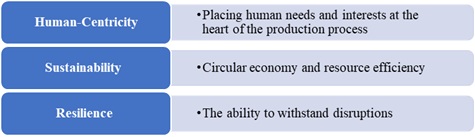
Figure 3. The three core pillars
The Directorate-General for Research and Innovation of European Commission (2022) characterizes Industry 5.0 as a paradigm in which “the wellbeing of the worker is prioritized within the production process”, leveraging innovative technologies to generate economic value that extends beyond conventional metrics. This paradigm shift necessitates that organizations cultivate capabilities in three fundamental pillars: human-centricity, sustainability, and resilience. Each of these pillars demands distinct leadership competencies that have yet to be fully explored by current research.
The present state of research in the field of Industry 5.0 is chiefly concentrated on establishing the fundamental concepts, identifying the technologies that will facilitate its realization, and delineating the prospective advantages of its implementation (Sterev & Yordanov, 2024). The extant literature demonstrates a significant gap concerning the organizational and human factors necessary to realize this vision (Sterev & Biolcheva, 2024). Specifically, there is a paucity of empirical research investigating the type of leadership required to navigate this complex transition, which involves not only technological upheaval but also a profound cultural shift towards collaboration, sustainability, and continuous learning.
The Transformational Leadership within Industry 5.0
The transformational leadership framework, originally developed by Burns (1978) and refined by Bass (1985), appears particularly suited to this paradigm. Transformational leaders inspire followers through idealized influence, inspirational motivation, intellectual stimulation, and individualized consideration – qualities that align with Industry 5.0’s emphasis on human potential and collaborative human-machine interaction.
The exploration of transformational leadership within the context of Industry 5.0 is increasingly pertinent as organizations navigate the complexities introduced by advanced technologies and cyber-physical systems. The authors provide a foundational understanding of leadership dynamics, highlighting the necessity for a holistic approach that considers the interplay between leaders, followers, and contextual factors (Avolio et al., 2009). Their research underscores the urgency for further investigation into how leadership styles evolve in technologically advanced environments, particularly with the advent of Industry 5.0, where effective human-machine collaboration is crucial for innovation and trust-building. This sets the stage for examining the specific practices of transformational leadership that can facilitate these interactions.
Building on this, Rocha-Jácome et al. (2021) propose a focused inquiry into the role of transformational leadership in the adoption of Industry 5.0. They emphasize the influence of leadership on technological innovation, organizational change, and workforce development, which are vital for achieving sustainable industrial transformation. Their findings suggest that “transformational leadership is not merely beneficial but essential for organizations” aiming to thrive in this new paradigm. However, there remains a significant gap in understanding how these leadership practices can be effectively implemented to foster an environment conducive to technological advancement and organizational resilience.
The transition to Industry 5.0 is not merely a technical upgrade; it is a strategic transformation. Transformational leadership, characterized by the Four I’s, is theoretically positioned as the critical catalyst for this change. This leadership style is essential for:
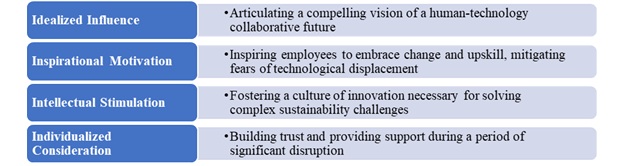
Figure 4. The Four I’s adaptation for implementation in an Industry 5.0 context
Conclusion
This paper synthesizes the current understanding of transformational leadership and the emerging paradigm of Industry 5.0. A substantial research gap has been identified, namely the dearth of empirical studies that explore the relationship between a specific transformational leadership style and the practical implementation and outcomes of Industry 5.0. Moreover, the human-centric approach is closely aligned with the focus of transformational leadership on individual consideration and intellectual stimulation. As business organizations transition towards collaborative human-machine environments, leaders must inspire workers to embrace technological change while maintaining their sense of purpose and dignity.
In light of discussion, the extant literature suggests a significant gap in understanding the specific mechanisms by which transformational leadership can be leveraged to enhance organizational performance in the context of Industry 5.0. This lacuna in the extant literature presents a valuable opportunity for researchers to formulate a research question that investigates the interplay between transformational leadership and the successful implementation of collaborative technologies in industrial settings. Conducting such a study would contribute to the extant body of knowledge and provide practical insights for organizations navigating the complexities of Industry 5.0.
Acknowledgement
The author acknowledges with gratitude funding provided by the Bulgarian National Research Fund under administrative contract KP-06-H65/5 of 12.12.2022.
References
Alves, J., Llima, T. M., & Gaspar, P. D. (2023). Is Industry 5.0 a human-centred approach? A systematic review. Processes, 11(1), 193. https://doi.org/10.3390/pr11010193.
Avolio, B. J., & Bass, B. M. (2004). Multifactor leadership questionnaire. (3rd Ed.). Mindgarden.
Avolio, B. J. (2010). Full range leadership development. Sage.
Avolio, B. J., Walumbwa, F. O., & Weber, T. J. (2009). Leadership: Current theories, research, and future directions. Annual review of psychology, 60(1), 421 – 449. https://doi.org/10.1146/annurev.psych.60.110707.163621.
Barling, J., Slater, F. & Kelloway, E. K. (2000). Transformational leadership and emotional intelligence: An exploratory study. Leadership and Organization Development Journal, 21(3), 157 – 163. https://doi.org/10.1108/01437730010325040.
Bass, B. M. (1999). Two decades of research and development in transformational leadership. European Journal of Work and Organizational Psychology, 8(1), 9 – 32. https://psycnet.apa.org/doi/10.1080/135943299398410.
Bommer, W. H., Rubin, R. S. & Baldwin, T. T. (2004). Setting the stage for effective leadership: antecedents of transformational leader behavior. Leadership Quarterly, 15, 195 – 210. https://psycnet.apa.org/doi/10.1016/j.leaqua.2004.02.012.
Bono, J. E., & Judge, T. A. (2003). Self-concordance at work: Toward understanding the motivational effects of transformational leaders. Academy of Management Journal, 46(5), 554 – 571. https://doi.org/10.5465/30040649.
Bucci, I., Fani, V., & Bandinelli, R. (2025). Towards human-centric manufacturing: Exploring the role of human digital twins in Industry 5.0. Sustainability, 17(1), 129. https://doi.org/10.3390/su17010129.
Downton, J. V. (1973). Rebel Leadership. Free Press.
European Commission. (2022) Industry 5.0: A transformative vision for Europe: Governing systemic transformations towards a sustainable industry. https://op.europa.eu/en/web/eu-law-and-publications/publication-detail/-/publication/38a2fa08-728e-11ec-9136-01aa75ed71a1.
Idriz, F. (2025). Leadership in tourism: From individual to business success. Industrial Growth Conference 2024, 186 – 195. https://doi.org/10.53656/igc-2024.20.
Lewis, E., Boston, D., & Peterson, S. (2017). A global perspective of transformational leadership and organizational development. Journal of Research Initiatives, 2(3), 5.
Mandell, B., & Pherwani, S. (2003). Relationship between emotional intelligence and transformational leadership style: A gender comparison. Journal of business and psychology, 17(3), 387 – 404.
Martin, C. A., & Bush, A. J. (2006). Psychological climate, empowerment, leadership style, and customer-oriented selling: an analysis of the sales manager-salesperson dyad. Academy of Marketing Science Journal, 34, 419 – 438.
Morton, W. (2012). Everything you need to know about emotional intelligence & leadership. BrainMass Inc.
Northouse, P. G. (2025). Leadership: Theory and practice. Sage publications.
Rocha-Jácome, C., González Carvajal, R., Muñoz Chavero, F., Guevara-Cabezas, E., & Hidalgo Fort, E. (2021). Industry 4.0: A proposal of paradigm organization schemes from a systematic literature review. Sensors, 22(1), 66. https://doi.org/10.3390/s22010066.
Ross, S. M., & Offermann, L.R. (1997). Transformational leaders: measurement of personality attributes and work group performance. Personality and Social Psychology Bulletin, 23, 1078 – 1086. https://doi.org/10.1177/01461672972310008.
Rubin, R. S., Munz, D. C. & Bommer, W. H. (2005). Leading from within: the effects of emotion recognition and personality on transformational leadership behavior. Academy of Management Journal, 48, 845 – 858. https://doi.org/10.5465/amj.2005.18803926.
Shin, S. J., & Zhou, J. (2003). Transformational leadership, conservation, and creativity: Evidence from Korea. Academy of Management Journal, 46(6), 703 – 714. https://doi.org/10.2307/30040662.
Shivers-Blackwell, S. (2006) The influence of perceptions of organizational structure and culture on leadership role requirements: The moderating impact of locus of control and self-monitoring. Journal of Leadership & Organizational Studies, 12, 27 – 49.
Sterev, N., & Biolcheva, P. (2024). Defining cognitive, behavioural and environmental factors in enhancing the value of artificial intelligence in business. Strategies for Policy in Science & Education, 32(6s), 11 – 24. https://doi.org/10.53656/str2024-6s-1-def.
Sterev, N., & Milusheva, V. (2024). Competitiveness of textile producers in digital business era. Strategies for Policy in Science & Education, 32(3s), 29 – 41. https://doi.org/10.53656/str2024-3s-3-com.
Sterev, N., & Yordanov, D. (2024). Academic entrepreneurship: practical results and training. Strategies for Policy in Science & Education, 32(6s), 150 – 162. https://doi.org/10.53656/str2024-6s-12-aca.
Stewart, J. (2006). Transformational leadership: An evolving concept examined through the works of Burns, Bass, Avolio and Leithwood. Canadian Journal of Educational Administration and Policy, 54.
Stogdill, R. (1974). Handbook of leadership: A survey of theory and research. Free Press.
Thomas, R. J. (2008). Crucibles of leadership: How to learn from experience to become a great leader. Harvard Business Press.
Dimityr Panchukov, PhD student
ORCID iD: 0009-0003-8655-8055
Department Industrial Business
University of National and World Economy
19, December 8th St.
1700 Sofia, Bulgaria
E-mail: dimityr.panchukov@unwe.bg
Assoc. Prof. Kaloyan Dimitrov, PhD
ORCID iD: 0009-0006-3752-3413
Department Industrial Business
University of National and World Economy
19, December 8th St.
1700 Sofia, Bulgaria
E-mail: kdimittrov@unwe.bg

Свързани статии:
 INTEGRATING LEAN PRINCIPLES WITH DIGITAL TECHNOLOGIES FOR THE IMPROVEMENT OF PRODUCTION MANAGEMENT
APPLICATION OF HUMAN-CENTERED APPROACH IN INDUSTRY 5.0 ‒ THE ROLE OF SMART LEARNING FOR SUSTAINABLE ECONOMIC GROWTH
TECHNOLOGICAL INNOVATIONS AND SUSTAINABLE DEVELOPMENT OF EUROPEAN SMALL AND MEDIUM-SIZED ENTERPRISES IN THE FOOD INDUSTRY
IMPLEMENTATION OF MACHINE LEARNING MODELS TO PREDICT FAILURE RATE OF RPA PROCESSES

